9 October 2026
By Dr Jichun (Jess) Hao, Clinical Psychologist | Rhythm Clinical Psychology, Sydney
In This Article
Why is it sometimes easier to speak up at work than to tell someone you love how you feel? This article explores how the interplay between vulnerability, past relationship experiences and your window of tolerance can influence the way you respond to conflict. You'll learn how to recognise when you're becoming overwhelmed and practical ways to regulate your nervous system, reconnect with your feelings and communicate your needs, even when difficult conversations feel uncomfortable.
Key Takeaways
You can be confident at work yet struggle to speak up in relationships because emotional vulnerability carries different stakes.
Your window of tolerance can help explain why difficult conversations sometimes leave you overwhelmed or unable to find your words.
Recognising your body's responses, using physical movement to regulate and practising difficult conversations can help you express yourself more authentically.
Meet Taylor
Taylor is confident and assertive at work. They manage a team of junior staff and regularly navigate difficult conversations with senior management. They can express their opinions, set boundaries and advocate for themselves when something doesn't feel right.
But in their close relationships, things feel different.
When Taylor and their partner, Cam, have a disagreement, Taylor struggles to express what they need or how they feel. They know what they want to say. They might even rehearse the conversation in their head beforehand. Yet when the moment arrives, their throat feels tight, their mind goes blank or goes racing, and the words seem impossible to get out.
The more distressed Cam becomes and the more they push for an answer, the more Taylor shuts down.
Afterwards, Taylor might replay the conversation, thinking of all the things they wish they had said. They may feel frustrated with themselves:
Why can I handle difficult conversations at work, but not with someone I love?
If this sounds familiar, you're not alone. Being articulate, capable and assertive in one area of life doesn't necessarily mean you'll find it easy to express yourself in emotionally vulnerable situations.
So, what might be happening?
One framework that can help us understand this experience is the window of tolerance.
What is the Window of Tolerance?
The window of tolerance describes a zone of emotional arousal in which we can experience feelings while remaining sufficiently regulated to think clearly, reflect on what's happening and respond flexibly.
When we're within this window, we can generally tolerate discomfort without becoming completely overwhelmed by it. We might feel hurt, anxious or frustrated, but we can still listen, find our words and consider different perspectives.
When emotional arousal becomes too intense, however, we may find it harder to access these capacities.
People can experience this in different ways:
Hyperarousal: You might feel anxious, overwhelmed, angry or desperate to resolve a situation. Your thoughts may race, and you might become defensive or feel an urgent need to respond.
Hypoarousal: You might feel numb, disconnected, foggy or emotionally flat. Your mind may go blank, your body might feel heavy, or you might struggle to speak at all.
It’s completely normal to move outside your window of tolerance for short periods when we experience stress or strong emotions. However, when we remain outside our window for a prolonged period, or find ourselves repeatedly moving outside it without enough time to recover, we may begin to feel overwhelmed, emotionally exhausted or disconnected.
How long it takes to return to our window varies from person to person and depends on factors such as the intensity of the stressor, our personal history and the resources available to us. Not everyone experiences emotional overwhelm in the same way.
For Taylor, shutting down during conflict might be a sign that the emotional intensity of the conversation is making it difficult to access the words and thoughts they would usually be able to express.
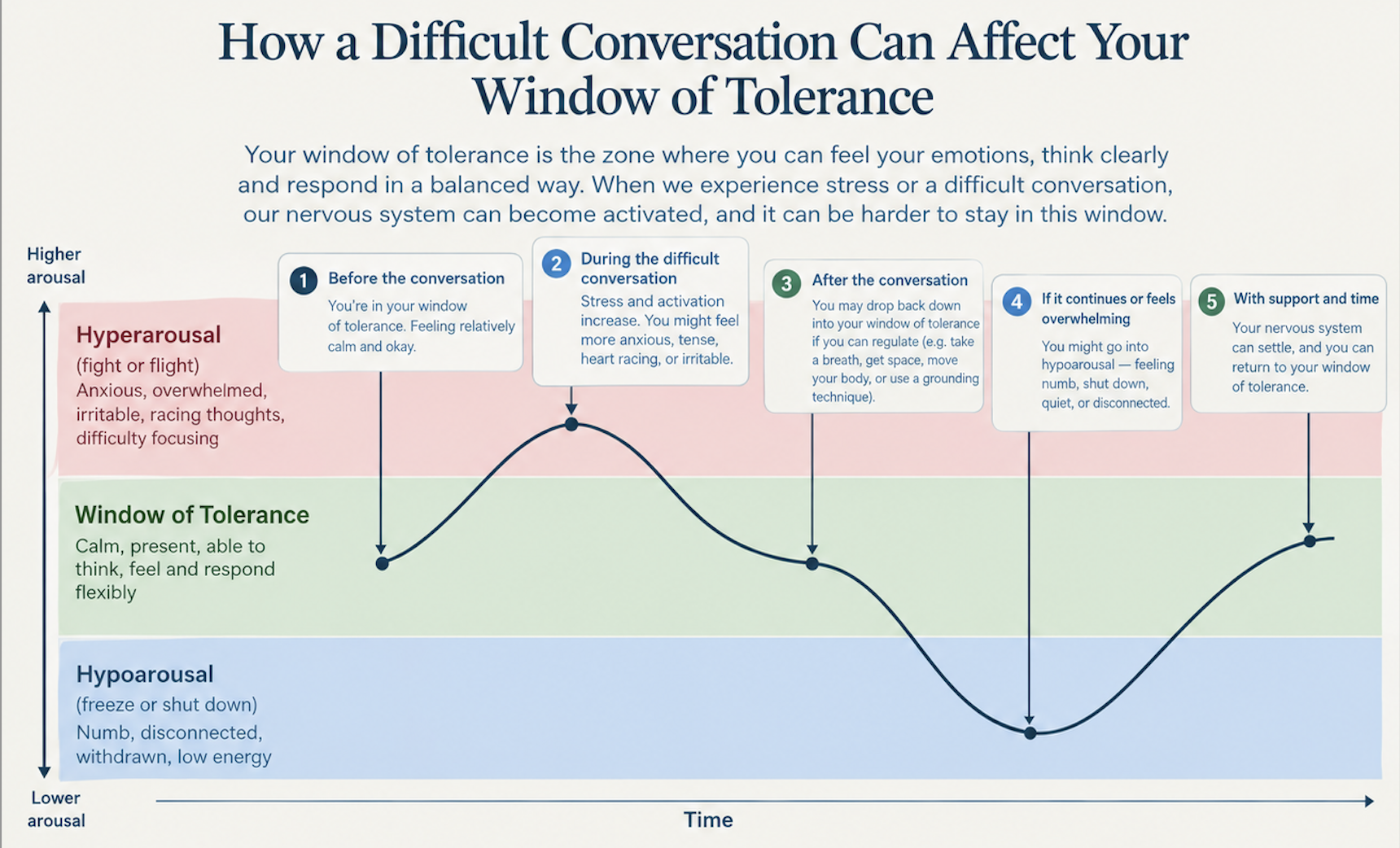
Note. Original illustration generated with the assistance of AI and reviewed by the author for clinical accuracy.
Why Can You Speak Up at Work but Struggle in Relationships?
Here are some of the reasons:
1. The emotional stakes are different
At work, disagreements may feel may feel less personally threatening.
In relationships, you may fear disappointing someone, damaging the connection or feeling guilty for expressing your needs (read more on guilt here).
Vulnerability can feel exposing when the relationship matters deeply to you.
2. You may be more invested in the other person’s response
You may become highly attuned to changes in their tone, expression or mood.
Your focus can shift from expressing your needs to calming them down or preventing conflict.
This can make it harder to recognise and communicate what you actually feel.
3. Old relational patterns can resurface
Childhood or past relationship experiences may shape how you respond to conflict and vulnerability.
You may have learned to keep the peace, minimise your feelings or prioritise others’ needs.
These patterns can persist even when you intellectually know it’s okay to disagree or express your needs.
Read more about how past experiences shape our relationship patterns.
4. Insight doesn’t always translate into action - read more here
You may understand your triggers and attachment patterns but still struggle when emotions run high.
This doesn’t necessarily mean you lack communication skills; you may need more practice and support expressing yourself in emotionally difficult moments.
5. Our nervous system can be protective, sometimes more than the situation requires
If speaking up has become associated with conflict or rejection, a difficult conversation may trigger a threat response, such as wanting to fight, escape, shut down or appease the other person.
Sometimes these responses may feel disproportionate to the situation; other times, your discomfort may be signalling something important about how you're being treated.
How This Can Show Up in Therapy
These patterns can also emerge in therapy, even in a supportive, non-judgmental environment. You might notice that you:
Feel nervous before a session, particularly when you know you'll be discussing something vulnerable.
Feel overwhelmed or struggle to find your words when talking about difficult emotions, even when your therapist has reassured you that there is no judgment.
Agree with your therapist in the moment, only to realise afterwards that you don't entirely agree or that something doesn't feel right.
Find it easier to explain your experiences intellectually than to connect with how you actually feel.
Feeling safe enough to be vulnerable can take time in therapy, and reassurance alone may not immediately ease your discomfort.
A therapeutic relationship can offer an opportunity to notice these patterns as they happen, explore them with curiosity and practise expressing yourself at a pace that feels manageable.
What Might Help?
-
If you tend to become overwhelmed, talk with your partner about what might help when you're both calm. You could agree on a way to signal that you need a pause and when you'll return to the conversation.
-
Notice what happens in your body and mind when a conversation becomes difficult. You might notice a tight throat, tense shoulders, racing thoughts, an urge to escape or difficulty finding words. Recognising these signs early can help you respond before you become overwhelmed.
-
What helps may depend on whether you're feeling highly activated or shutting down.
If you're experiencing hyperarousal (e.g., anger, anxiety, racing thoughts or feeling overwhelmed): Try slowing your breathing, relaxing muscle tension or taking a brief break from the conversation. If anger is building, stepping away before responding may help you avoid reacting impulsively. If you're feeling anxious, try surfing the wave: notice how anxiety feels in your body and allow it to rise and fall without feeling you have to act on it immediately.
If you're experiencing hypoarousal (e.g., feeling numb, disconnected or frozen): Try gently stretching, standing up, walking around or looking around the room and naming what you see. These movements and sensory cues may help you reconnect with the present moment.
Different strategies work for different people. The aim isn't to force yourself to continue the conversation, but to create enough space to choose your next step. You might also want to co-regulate with your partner, like doing for a walk together.
-
Ask yourself: What am I feeling? What do I need this person to understand? What am I afraid might happen if I speak up?
It can also help to separate what you know from what you're assuming. For example, if your partner seems quiet, you might automatically assume they're angry with you. Pause and consider what you know for sure, and whether there might be another explanation. This doesn't mean dismissing your instincts or overlooking genuine problems; it simply creates space to check your interpretation before reacting.
You don't need perfect answers. Even identifying one feeling or need can help you communicate more clearly.
-
You don't have to communicate everything perfectly in one conversation. Start with something manageable, such as saying, "I felt a little hurt when that happened, and I'd like to talk about it."
Writing down your key points, rehearsing an opening sentence or role-playing with a trusted friend or therapist can also help you feel more prepared. The aim isn't to memorise a perfect script, but to become more comfortable expressing yourself when emotions are involved.
-
Speaking up may mean disappointing someone, hearing a different perspective or experiencing temporary tension. If you're used to keeping the peace or prioritising other people's feelings, this discomfort can be particularly challenging.
You can express your needs respectfully without being responsible for managing every reaction. The goal isn't to avoid all discomfort, but to learn that you can experience it and still act in line with your values.
-
You may still go quiet, lose your words or find yourself avoiding a conversation sometimes. Rather than criticising yourself, reflect on what happened and what might help next time.
Learning to communicate through discomfort takes practice. Each small moment of recognising your feelings, expressing a need or returning to a difficult conversation can help build confidence over time.
It's also important to consider whether the relationship feels emotionally safe. If expressing concerns regularly leads to intimidation, punishment or repeated dismissal, the difficulty may not be explained by your nervous system alone. You deserve to have your feelings and boundaries treated with respect.
The Path Forward
If this feels familiar, you are not alone.
Understanding your window of tolerance can partially help explain why difficult conversations feel overwhelming, even when you know what you want to say. With awareness and practice, you can learn to navigate discomfort and communicate more confidently while staying true to yourself.
If this resonates with you and you would like to explore therapy, we would love to hear from you. Rhythm Clinical Psychology provides individual therapy (rather than couples counselling) for adults wanting to better understand their relationship patterns, have more difficult conversations, and build healthier relationships from their own side of the equation. Rhythm Clinical Psychology is based in Surry Hills, Sydney, and we also offer telehealth sessions for those based elsewhere in Australia. You can reach us at info@rhythmclinicalpsychology.au or by calling 0414 824 375.
This is the second article in our series on Relationship Psychology. You can read the first article here.

-
This article is provided for general informational and educational purposes only and is based on psychological theory and clinical experience. It is not intended to be, and should not be used as, a substitute for professional psychological assessment, diagnosis, or treatment.
The content reflects general patterns observed in clinical practice and may not apply to all individuals. If you are experiencing distress or relate to the material discussed, you are encouraged to seek support from a qualified health professional, such as a registered psychologist, or to discuss your concerns with your treating clinician.
This information is not a substitute for personalised care.
-
Chervonsky, E., & Hunt, C. (2017). Suppression and expression of emotion in social and interpersonal outcomes: A meta-analysis. Emotion, 17(4), 669–683. https://doi.org/10.1037/emo0000270
Corrigan, F. M., Fisher, J. J., & Nutt, D. J. (2011). Autonomic dysregulation and the window of tolerance model of the effects of complex emotional trauma. Journal of psychopharmacology, 25(1), 17-25.
Lindsey, E. W. (2020). Relationship context and emotion regulation across the life span. Emotion, 20(1), 59–62. https://doi.org/10.1037/emo0000666
9 October 2026
By Dr Jichun (Jess) Hao, Clinical Psychologist | Rhythm Clinical Psychology, Sydney