When Insight Isn’t Enough: High-Functioning Anxiety in Schema Therapy
20 May 2026
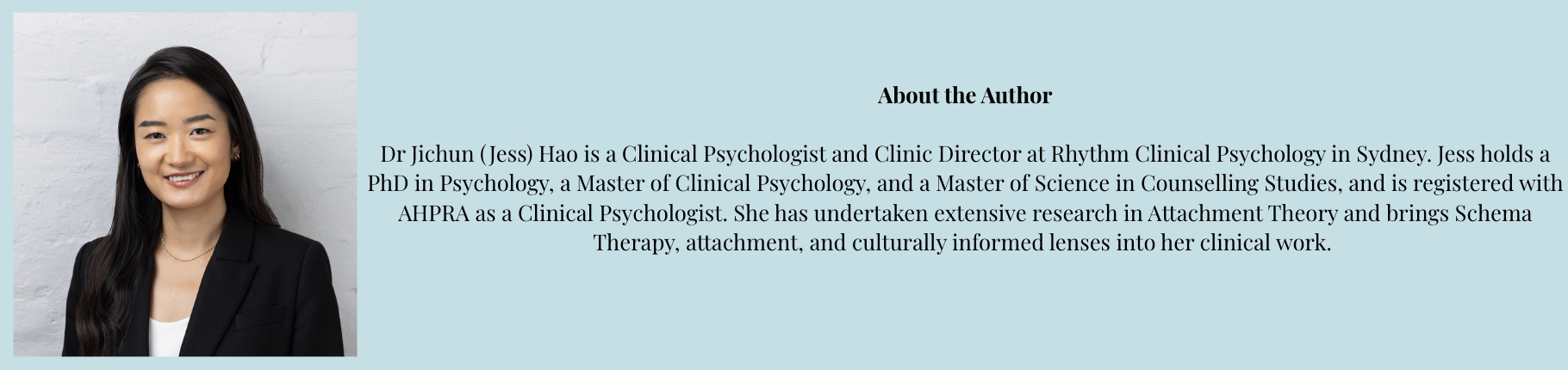
By Dr Jichun (Jess) Hao, Clinical Psychologist | Rhythm Clinical Psychology, Sydney
In This Article
In this article, we explore high-functioning anxiety through a Schema Therapy lens. Using the example of Alex, we'll look at how early experiences can shape beliefs about self-worth, emotional needs, and relationships—and why understanding these patterns is often not enough to create lasting change. We'll also explore how Schema Therapy aims to shift emotional patterns through new experiences, not just new insights.
Key Takeaways
High-functioning anxiety often persists even with insight, because these patterns are emotional and relational, not purely cognitive, and were learned over time through repeated experience.
Schema Therapy explains how unmet core emotional needs in childhood (such as autonomy, freedom of expression, and spontaneity) can lead to Early Maladaptive Schemas that shape how we think, feel, and cope as adults.
Common schemas linked to high-functioning anxiety include Unrelenting Standards, Defectiveness/Shame, Emotional Deprivation, Approval-Seeking, and Self-Sacrifice.
People often cope with these schemas through Overcompensation (over-achieving) and Surrender (pushing through exhaustion to meet others' needs), creating a self-reinforcing cycle of overworking and depletion.
Achievement and caretaking can unintentionally reinforce these patterns, since recognition and praise provide short-term relief even as they perpetuate over-responsibility.
Lasting change usually requires more than cognitive insight. It involves repeated emotional experiences of safety, validation, and connection, often within a different kind of relationship than earlier ones.
Therapy approaches such as chair work, imagery rescripting, and corrective emotional experiences aim to create new emotional experiences, not just new understanding, helping shift these patterns at a felt, not just intellectual, level.
Do You Recognise These Signs of High-Functioning Anxiety?
Alex is 35 and has a successful career built through years of hard work at school, university, and in their job.
They are the child their family relies on emotionally. They organise social gatherings, show up when needed, and are often described as:
“a hard worker”
“calm under pressure”
“someone we can always rely on”
“someone who gets things done”
On the outside, Alex is functioning well.
But internally, things feel very different.
They feel lonely and empty sometimes. They experience constant mental overactivity—ruminating about work, planning, and responsibilities. Even when they try to rest, they feel restless and guilty, as though they should be doing something productive. They find it easier to advocate for others than for themselves.
They have read about high-functioning anxiety. They understand the symptoms.
They have tried Cognitive Behavioural Therapy (CBT), meditation, breathing exercises, exercise, and thought-challenging strategies.
They have also reflected deeply on why they became the “high achiever,” “hard worker,” or “perfectionist.”
And yet, they find themselves asking:
“I understand myself… so why do I still feel stuck in the same patterns?”
When Insight Alone Doesn’t Lead to Change
This is one of the most common frustrations in therapy, and from a Schema Therapy perspective, it makes sense.
These patterns are not only cognitive—they are emotional, relational, and deeply learned over time. Understanding them is important, but understanding alone is often not enough to change them.
Over time, these patterns are formed and reinforced through repeated experiences, which is why change requires more than insight alone.
A helpful metaphor:
Imagine using your right hand for your entire life. Now imagine trying to switch to your left hand overnight.
Knowing you want to change is not enough. New pathways need to be built through repeated experience and practice, which can feel uncomfortable or even threatening at first. Emotional change often works in the same way.
These patterns may continue to be reinforced in the present. By working hard and performing well, Alex receives recognition, praise, achievement, and a sense of competency. While these outcomes are not inherently negative, they might unintentionally reinforce patterns of overworking, over-responsibility, and self-sacrifice.
In addition, lasting change usually requires more than cognitive insight. It involves repeated lived experiences of emotional safety, validation, and connection—often in relationships that are different from earlier relational experiences.
For Alex, this might mean gradually learning that they can still feel valued, connected, and understood even when they are not performing, helping, or achieving.
For some people, insight can remain largely intellectual rather than embodied or experiential—understanding patterns intellectually without fully experiencing or emotionally processing them. This may partly explain why someone like Alex can read countless self-help books, listen to podcasts, or watch videos about anxiety, yet still feel stuck in the same emotional patterns.
Our nervous system prioritises predictability and familiarity. As a result, even exhausting patterns may feel safer than uncertainty or vulnerability. If achievement, productivity, and caretaking have long been the ways Alex has experienced safety, worth, or identity, it can feel difficult to know who they are without them.
For some people, this process may also bring up grief, anger, or sadness, as they begin to recognise that their emotional needs were not fully met earlier in life.
To better understand why these patterns form in the first place—and how they are maintained over time—it can be helpful to look at them through a Schema Therapy lens.
-
According to Schema Therapy, long-standing patterns around high functioning anxiety are not just cognitive—they are also emotional, relational, and deeply learned over time.
Basic Emotional Needs
We all have five core emotional needs:
Secure attachment: to feel safe, loved, and connected
Autonomy: to develop confidence, independence, and a stable sense of self
Freedom of expression: to feel that our emotions, needs, and opinions matter
Spontaneity and play: to experience joy, creativity, curiosity, and rest
Realistic limits: to learn healthy boundaries, self-control, and responsibility
When these needs are consistently met, we tend to develop emotional resilience, secure relationships, and a stable sense of self.
However, when they are not consistently met in childhood, we may develop Early Maladaptive Schemas (or Schemas)—deep patterns that shape how we think, feel, and cope, even after we are out of the original environment that shaped these schemas.
These influence:
how we think about ourselves and the world (thoughts and rules)
how we emotionally experience ourselves and others (feelings)
how we cope with distress (Coping Modes)
Coping Modes
There are three coping modes-the ways we respond to emotional pain triggered by schemas:
Surrender: giving in to the schema
Avoidance: avoiding triggers or emotional discomfort
Overcompensation: doing the opposite of the schema in an attempt to disprove it.
Over time, our coping modes can also reinforce these patterns, creating a self-perpetuating cycle.
-
In clinical practice, people with high-functioning anxiety may often have unmet needs around:
Freedom of expression
Spontaneity and play
Autonomy
They may have also developed schemas such as:
Unrelenting Standards: “I must always perform well.”
Defectiveness/Shame: “There is something wrong with me.”
Emotional Deprivation: “My emotional needs are not that important, and strong, independent people don’t have such needs.”
Approval-Seeking: “My sense of self depends on others’ approval.”
Self-Sacrifice: “Others come first, even at my expense.”
Although they might use all three coping modes at different times, their dominant one might be Overcompensation and Surrender.
A Clinical Example: Alex’s Pattern
Now we return to Alex’s example. As a child, Alex may have been the “reliable one” or “good one.”
They may have been praised for:
academic achievement
helping at home
being responsible or low-maintenance
It’s likely that they had limited opportunities to freely and fully experience or express their emotions, and may not have been encouraged to be spontaneous or to engage in play purely for enjoyment and joy. They may have become more attuned to what others needed from them than to what they needed themselves.
Over time, they could have learned a set of conditional rules about worth:
“I am only valued when I perform well, help others, and stay in control.”
It’s possible that these patterns have made them successful—but also could have set the foundation for high-functioning anxiety in adulthood.
To manage the emotional distress linked to these beliefs, Alex might have heavily relied on:
Overcompensation: over-working and over-achieving in an attempt to disprove underlying beliefs of Defectiveness/Shame, or
Surrender: complying with schemas such as Unrelenting Standards or Emotional Deprivation, leading them to push through exhaustion or prioritise others’ needs over their own.
Together, these create a cycle of overworking, over-responsibility, and emotional depletion-contributing to high-functioning anxiety.
What once supported Alex’s sense of competence and worth may now also keep them stuck. While they can recognise this pattern logically, emotionally it can feel difficult to change, as these responses are deeply learned and tend to operate automatically.
What Might Help Change?
In therapy with us, we do not solely focus on identifying or challenging thoughts; we also work experientially with emotional patterns and support clients in developing healthier ways of responding to unmet emotional needs.
This may include:
Mode awareness: recognising when coping modes such as overcompensation and avoidance become activated
Chair work: engaging with different parts of the self in dialogue
Imagery rescripting: revisiting and reshaping earlier emotional experiences
Corrective emotional experiences: through limited reparenting within a safe, boundaried therapeutic relationship
Behavioural pattern-breaking: gradually practising new ways of responding in daily life
Emotion regulation skills: strategies that support nervous system regulation and emotional tolerance (e.g., progressive muscle relaxation)
Self-compassion and Healthy Adult development: building a more flexible and emotionally supportive relationship with oneself
Over time, these experiences help shift patterns at an emotional level—not just an intellectual one.
The goal is not perfection.
The goal is flexibility.
The Path Forward
If this feels familiar, you are not alone.
Change often involves more than understanding. It involves new emotional experiences over time, in safe and supportive relationships.
If this resonates with you and you would like to explore therapy, we would love to hear from you. Rhythm Clinical Psychology is based in Surry Hills, Sydney, and we also offer telehealth sessions for those based elsewhere in Australia. You can reach us at info@rhythmclinicalpsychology.au or by calling 0414 824 375.
This is the first article in our series on high-functioning anxiety. You can read the second article here and the third article here.
-
This article is provided for general informational and educational purposes only and is based on psychological theory and clinical experience. It is not intended to be, and should not be used as, a substitute for professional psychological assessment, diagnosis, or treatment.
The content reflects general patterns observed in clinical practice and may not apply to all individuals. If you are experiencing distress or relate to the material discussed, you are encouraged to seek support from a qualified health professional, such as a registered psychologist, or to discuss your concerns with your treating clinician.
This information is not a substitute for personalised care.
-
Behind the mask: Managing high-functioning anxiety. Retrieved from https://www.mayoclinichealthsystem.org/hometown-health/speaking-of-health/managing-high-functioning-anxiety on 15th of May 2026.
Maenpaa, J. (2022). Working with high functioning anxiety: Supporting our overachievers. continued.com - Social Work, Article 165. Available at www.continued.com/social-work
Peeters, N., van Passel, B., & Krans, J. (2022). The effectiveness of schema therapy for patients with anxiety disorders, OCD, or PTSD: A systematic review and research agenda. British Journal of Clinical Psychology, 61(3), 579-597.
The Schema Therapy Model. Retrieved from https://schematherapysociety.org/Schema-Therapy on 15th of May 2026.
Wright, A., (2026). Schema Therapy for Driven Women: Rewriting the Invisible Rules of Your Life. Retrieved from https://anniewright.com/schema-therapy-for-driven-women-rewriting-the-invisible-rules-of-your-life/ on 15th of May 2026.
Young, J. E., Klosko, J. S., & Weishaar, M. E. (2006). Schema therapy: A practitioner's guide. Guilford press.
20 May 2026
By Rhythm Clinical Psychology