High-Functioning Anxiety and Relationships: An Attachment Theory Perspective
09 June 2026
By Dr Jichun (Jess) Hao, Clinical Psychologist | Rhythm Clinical Psychology, Sydney
In this Article
In this article, we explore how high-functioning anxiety can affect relationships through an attachment theory lens. Using the example of Alex again, we'll look at how competence, self-reliance, and caretaking can become ways of maintaining connection and emotional safety—and why this may make vulnerability, emotional intimacy, and receiving support more difficult.
Key Takeaways
High-functioning anxiety in relationships is often expressed through competence, over-functioning, and self-reliance, rather than visible emotional distress.
Attachment theory helps explain how these patterns develop and persist, linking early relational experiences to adult relationship styles and emotional safety strategies.
Attachment styles are flexible, not fixed. The same person may shift between anxious (pursuit) and avoidant (withdrawal) attachment strategies depending on the relationship dynamic.
Competence, caretaking, and people-pleasing can function as attachment strategies, used to maintain connection while avoiding vulnerability or emotional dependence.
High-functioning anxiety and attachment insecurity often involve difficulty with emotional availability, including expressing needs, receiving support, and tolerating emotional closeness.
Underlying beliefs such as “I am valued when I perform or help others” reinforce relational patterns of over-responsibility and emotional self-management.
Change involves expanding beyond competence-based relating toward emotional openness and interdependence, including vulnerability, reciprocity, and secure attachment experiences.
When High-Functioning Anxiety Affects Relationships
You may appear calm, capable, and successful on the outside — the person others rely on, who seems to have everything under control. Yet relationships can feel surprisingly difficult.
You might find yourself replaying conversations long after they have ended, worrying about disappointing the people you care about, or struggling to ask for support when you need it.
For many people with high-functioning anxiety, relationships involve a constant tension between wanting closeness and trying to maintain control. Vulnerability can feel uncomfortable or unfamiliar, so they may find themselves focusing on being helpful, responsible, or accommodating rather than openly expressing emotional needs.
Do You Recognise Yourself?
People with high-functioning anxiety often relate to some of the following:
Overthinking relationships
Fear of disappointing others
Difficulty asking for support
People-pleasing and conflict avoidance
Feeling emotionally overwhelmed, frozen, or shut down during conflict
Wanting connection but struggling with vulnerability
If several of these feel familiar, attachment theory may help explain why these patterns can feel so persistent.
To see how this can play out in everyday life, let's return to Alex from our piece on Schema Therapy and high-functioning anxiety here.
Alex is 35 and has built a successful career through years of hard work and responsibility. They are often described as dependable, calm under pressure, and someone who always gets things done. On the surface, Alex appears to be functioning well.
Internally, however, things feel very different. Alex experiences constant mental overactivity, struggles to switch off, and often feels guilty when resting. They find it easier to advocate for others than for themselves.
These same patterns also begin to shape Alex's relationships. Although Alex values connection, they often feel uncomfortable depending on others emotionally. During moments of conflict or emotional closeness, they may become overwhelmed, overthink how they should respond, prioritise the other person's needs, or struggle to stay connected to their own feelings.
This is a common frustration that people bring to therapy. As explored in our earlier piece on Schema Therapy and high-functioning anxiety, insight alone does not always lead to emotional change. Attachment theory offers another lens through which we can understand these relational patterns.
-
Attachment theory proposes that we all have an attachment system that is biologically based and supports survival by motivating us to seek safety and connection with others. According to attachment theory, this system becomes activated when we feel distressed or emotionally unsafe, leading us to seek reassurance, support, or closeness from significant others. Once we feel safe again, this system becomes deactivated, allowing us to return to exploration and daily life.
A helpful metaphor:
A young child is exploring a playground while occasionally looking back at their caregiver. If the child falls over or becomes distressed, they may return for comfort and reassurance. When the caregiver feels emotionally available and responsive, the child often feels safe enough to return to exploring the world around them.Early attachment experiences help shape internal templates for relationships based on how emotionally available and responsive caregivers are during early childhood. These templates then influence how we view ourselves, others, and relationships. Early in life, attachment bonds usually form with caregivers, and later in adulthood, with romantic partners and other close relationships. Although attachment patterns tend to be relatively stable, they can also change over time through subsequent experiences, such as important romantic relationships and therapy, and may differ across relationships.
Different relationships can also bring out different attachment strategies. For example, a person may seek more reassurance and closeness in one relationship, while relying more heavily on self-sufficiency or emotional distance in another, depending on the relationship dynamic and how emotionally safe they feel.
Research generally describes three main adult attachment patterns:
Secure attachment: feeling relatively comfortable with both closeness and independence, and being able to rely on both oneself and others for support. This is often associated with caregivers who were generally emotionally responsive and supportive of exploration.
Anxious/Preoccupied attachment: placing greater focus on obtaining reassurance, closeness, or validation from others, often alongside fears of rejection or abandonment. This is often associated with inconsistent emotional responsiveness from caregivers.
Avoidant/Dismissing attachment: relying heavily on oneself while feeling less comfortable with emotional dependence, vulnerability, or relying on others for support. This is often associated with caregivers who were less emotionally available or responsive to emotional needs.
Some researchers also describe a fourth pattern, known as Disorganised/Fearful attachment, which may involve a combination of anxious and avoidant patterns.
These attachment patterns are often understood through two underlying dimensions:
how we view ourselves (e.g., worthy or unworthy of love and care)
how we view others (e.g., emotionally available or unavailable)
At its core, attachment theory helps us understand how earlier relational experiences can continue to shape the ways we seek safety, closeness, and connection within relationships.
Attachment patterns are often understood through how we view ourselves and others. The diagram below provides a simplified overview.
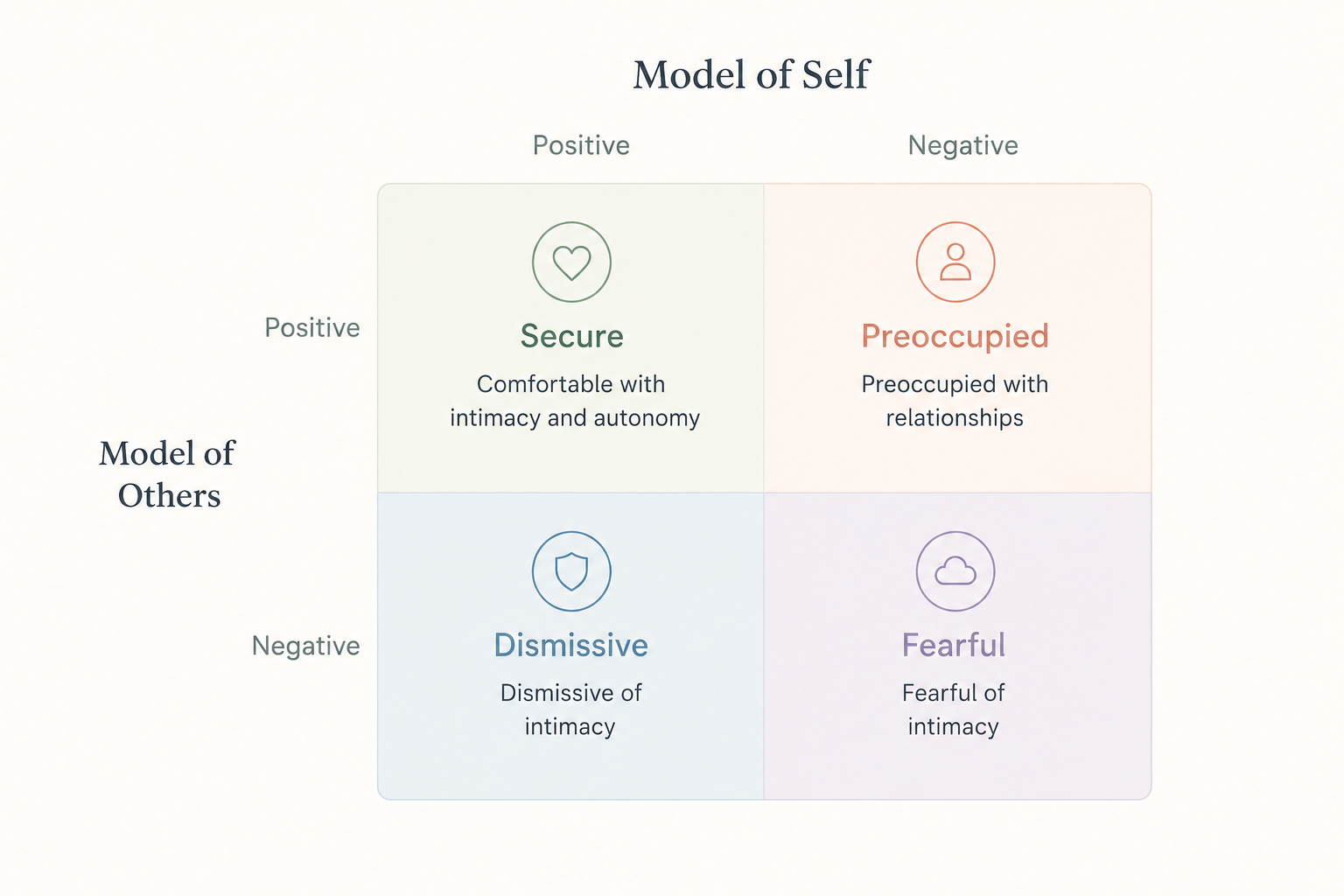
Adapted from Bartholomew & Horowitz (1991) model of attachment based on models of self and other.
-
Now we return to what’s happening for Alex. In this case, attachment insecurity does not necessarily appear through obvious dependency, emotional volatility, or withdrawal. Instead, it may show up through competence, self-reliance, and over-functioning.
If you recall, we explored Alex’s upbringing in our piece on when insight alone does not create change here. To recap:
When Alex was younger, they may have been praised for:
academic achievement
helping at home
being responsible or low-maintenance
It’s likely that Alex had limited opportunities to fully experience or express their emotions, and may not have been encouraged to engage in spontaneity or play simply for enjoyment. They may have become more attuned to what others needed from them than to what they needed themselves.
Over time, they may have developed conditional beliefs about worth, such as:
“I am only valued when I perform well, help others, and stay in control.”
From a Schema Therapy perspective, these patterns may reflect schemas such as Unrelenting Standards, Self-Sacrifice, Emotional Deprivation, or Defectiveness/Shame. Read more about Schema Therapy, high-functioning anxiety, and why insight alone is not enough for change. From an attachment perspective, competence may have become a way for Alex to maintain emotional safety in relationships. This can look different depending on how their attachment system responds within different relationships.
Alex's Anxious Attachment Strategies (Hyperactivation Strategies)
With one partner, Sam, who is more independent and self-reliant, Alex finds themselves admiring Sam’s independence while also feeling increasingly anxious about the relationship and wanting more closeness and reassurance. Alex is usually the one who messages first and organises the next date. While doing this, Alex worries they might appear too “needy” or “clingy” to Sam. Alex often feels disappointed when they cannot see each other but finds it difficult to express this directly. Over time, Alex may give up time to rest or go to the gym so they can remain available in case Sam wants to spend time together. Rather than directly expressing a desire for more closeness or reassurance, Alex may focus on being helpful, accommodating, people-pleasing, or needed. This may feel emotionally safer than openly expressing vulnerability or emotional needs.
However, there are also moments where Alex’s strategy looks less like pursuit of connection — and more like withdrawal into self-reliance.
Alex's Avoidant Attachment Strategies (Deactivating Strategies)
In another relationship, Jamie tends to bring out more self-reliance in Alex. When Alex met Jamie, Jamie had recently moved interstate and was going through a career transition. When Jamie needs emotional or practical support, Alex takes pride in providing it. Alex spends entire weekends helping Jamie buy furniture and listening to frustrations about job searching. Over time, however, Alex finds it increasingly difficult to say no to Jamie’s requests, while also rarely feeling they have space to seek support for themselves. During arguments, Alex may become emotionally overwhelmed or shut down. Rather than expressing their own feelings or needs, they focus on resolving the conflict quickly and ensuring Jamie is no longer upset. If Jamie asks, “What’s wrong?”, Alex might respond, “Nothing is wrong,” even when they are struggling internally.
At times, Alex may even find themselves wondering whether it would be easier not to be in a relationship at all. Remaining self-reliant can feel safer than risking the vulnerability, uncertainty, or disappointment that often comes with emotional dependence on others.
In these moments, competence becomes a way for Alex to stay emotionally contained.
When Competence Becomes the Relationship Strategy
As you can see, although these relationship dynamics look different, both reflect Alex’s tendency to rely on competence, caretaking, and self-management to maintain connection and emotional safety. Depending on the relationship dynamic, this may appear more anxiously focused on maintaining closeness, or more avoidantly focused on emotional self-reliance. Alex is neither purely anxiously nor avoidantly attached. Alex's conditional beliefs about self-worth (e.g., "I am only valued when I perform well, help others, and stay in control") may help explain why these strategies emerge in different ways across relationships.
With Sam, who perhaps prefers more distance and space, Alex may over-function or over-accommodate to feel valued, connected, and reassured. With Jamie, being needed or depended on may feel emotionally safer and more familiar for Alex, as it reflects the role they learned to adopt earlier in life rather than openly expressing vulnerability or emotional needs themselves.
People with high-functioning anxiety like Alex might know how to:
function,
support others,
maintain stability.
But struggle with experiencing relationships:
expressing emotional needs directly
vulnerability and emotional openness
receiving care or relying on others emotionally
mutuality and emotional reciprocity within relationships
feeling seen, understood, and emotionally connected
In other words,
“Relationships require emotional availability, not just competence.”
That mismatch is where relational difficulty often emerges. Deep down, Alex may still long to feel emotionally seen, valued, and supported within relationships — but feel unsure how to reach for this directly, especially when vulnerability itself feels uncomfortable or unsafe.
Over time, Alex may find that they are deeply connected to others functionally, but not always emotionally met in return. These strategies are not flaws. They often develop as understandable attempts to find safety, connection, and belonging in relationships.
Key Takeaway
High-functioning anxiety can sometimes lead people to seek connection through competence, caretaking, or self-reliance rather than through vulnerability and emotional openness. While these strategies may help maintain relationships, they can also make it harder to feel emotionally seen and supported.
-
We explored ways of shifting emotional patterns — not just rational or cognitive patterns — in our article on why insight alone is often not enough for change.
For Alex, the challenge is not a lack of relational capacity. Rather, their way of relating has long been organised around competence, responsibility, and emotional self-management.
Over time, the goal is for Alex to develop a felt sense that their worth and connection are not dependent on performance, emotional control, or always being the helper:
“I am valued not only when I perform or stay in control, but also when I feel, connect, depend on others, and allow myself to be vulnerable.”
From an attachment perspective, therapy may involve gradually learning that emotional closeness, vulnerability, and dependence do not necessarily lead to rejection, disappointment, loss of control, or having one's needs ignored. This may involve:
Corrective emotional experiences: experiencing safe, emotionally attuned relationships within therapy
Recognising relational patterns: noticing people-pleasing, over-functioning, or emotional shutdown in real time and within the therapy relationship
Building emotional tolerance: learning to stay present with emotional experiences while using grounding, breathing, or other somatic strategies to support regulation
Assertiveness training: practising direct communication and asking for support
Developing self-compassion: reducing harsh self-criticism and performance-based self-worth through experiential and imagery-based techniques
Developing interdependence: becoming more comfortable both receiving support and sharing needs with others
Increasing spontaneity and play: reconnecting with enjoyment, rest, and authenticity outside of productivity and caretaking
Rather than becoming less capable, the goal is often to expand beyond competence as the primary way of relating.
The Path Forward
If this feels familiar, you are not alone.
Over time, the goal is not simply to become more competent in relationships, but to feel safer being emotionally open, vulnerable, and connected within them.
If this resonates with you and you would like to explore therapy, we would love to hear from you. Rhythm Clinical Psychology is based in Surry Hills, Sydney, and we also offer telehealth sessions for those based elsewhere in Australia. You can reach us at info@rhythmclinicalpsychology.au or by calling 0414 824 375.
This is the second article in our series on high-functioning anxiety. You can read the first article here and the third article here.
-
This article is provided for general informational and educational purposes only and is based on psychological theory and clinical experience. It is not intended to be, and should not be used as, a substitute for professional psychological assessment, diagnosis, or treatment.
The content reflects general patterns observed in clinical practice and may not apply to all individuals. If you are experiencing distress or relate to the material discussed, you are encouraged to seek support from a qualified health professional, such as a registered psychologist, or to discuss your concerns with your treating clinician.
This information is not a substitute for personalised care.
-
Bartholomew, K., & Horowitz, L. M. (1991). Attachment styles among young adults: A test of a four-category model. Journal of Personality and Social Psychology, 61(2), 226–244. https://doi.org/10.1037/0022-3514.61.2.226
Hao, J. (2025). Attachment, mindfulness, and social integration in the adjustment of Australian and Chinese university students: a cross-cultural comparison (Version 1). Open Research Newcastle. https://hdl.handle.net/1959.13/1405218
Ho, J. (2024). The New Rules of Attachment: How to Heal Your Relationships, Reparent Your Inner Child, and Secure Your Life Vision. Hachette UK.
Kowalska, A. (2025). Psychological Determinants of Intimacy Avoidance in High-Achieving Women with Attachment Insecurity. Psychology of Woman Journal, 6(4), 1-9. https://doi.org/10.61838/kman.pwj.4332
09 June 2026
By Rhythm Clinical Psychology