13 Nov 2026
By Dr Jichun (Jess) Hao, Clinical Psychologist | Rhythm Clinical Psychology, Sydney
In This Article
In this article, we explore what happens when difficulties arise in the therapeutic relationship, how transference and countertransference can contribute to ruptures, and why working through these moments matters. Through three everyday scenarios, we look at how misunderstandings and disconnection can develop, how therapists and clients can work towards repair, and what it means when a rupture cannot be resolved.
Key Takeaways
Ruptures are a normal part of therapy. Misunderstandings, disconnection and moments of feeling unheard can occur even in a strong therapeutic relationship.
Both transference and countertransference can shape ruptures. A client's expectations and fears, alongside a therapist's emotional responses, can unintentionally reinforce relational patterns.
Ruptures can create opportunities for change. When difficulties are acknowledged and explored collaboratively, repair can deepen trust and support new relational experiences.
You don't have to protect your therapist from difficult feelings. Sharing concerns about therapy can be an important part of the therapeutic process.
Not every rupture can be repaired. If difficulties persist despite genuine efforts to address them, it may be worth reconsidering whether the therapeutic relationship is the right fit.
Repair is a shared process, not the client's responsibility alone. Therapists have a professional responsibility to remain open to feedback, reflect on their contribution and work collaboratively towards understanding.
When Patterns Meet in the Therapy Room
In the previous two articles, we explored transference and countertransference separately. However, these are not isolated experiences occurring independently within the client and therapist. They can interact and shape the therapeutic relationship, just like any other relationships.
For instance, a client who fears disappointing others may become especially attentive to their therapist’s reactions. The therapist, in turn, might feel an urge to reassure the client or become frustrated when the client avoids difficult material. If the therapist responds to their frustration by becoming more direct or impatient, the client may interpret this as evidence that they have let the therapist down. A rupture may develop, reinforcing the client’s fear that relationships are conditional or that they must manage other people’s feelings to maintain connection.
The result can be a relational cycle in which each person’s response unintentionally reinforces the other’s expectations. These patterns are not necessarily anyone’s fault; rather, they emerge through the interaction between two people, often outside either person’s awareness.
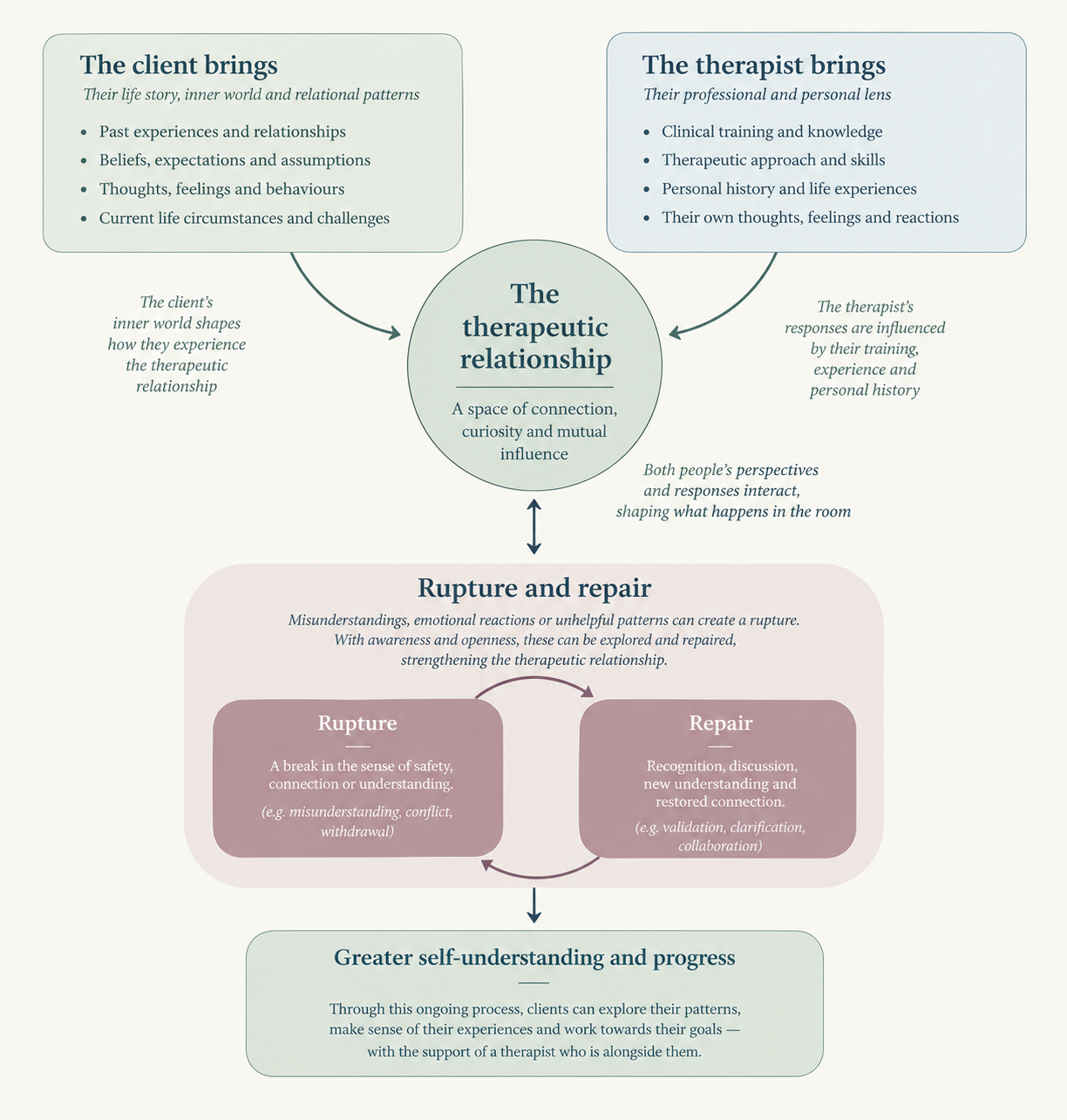
Note. Original illustration generated with the assistance of AI and reviewed by the author for clinical accuracy.
“There seems every reason to suppose that the therapeutic relationship is only one instance of interpersonal relations, and that the same lawfulness governs all such relationships.”
-
Therapy can offer a setting in which relational patterns that occur in everyday life become visible as they unfold. A client who fears disappointing others, for example, may experience similar fears in their relationships outside therapy. When these patterns emerge in the therapeutic relationship, they create an opportunity to explore not only what the client has come to expect from others, but also how these expectations shape their responses in the present moment.
The therapist’s task is not simply to identify the client’s patterns, but also to reflect on their own emotional responses and how these might be contributing to the interaction. This is where recognising countertransference becomes important. By becoming curious about what is happening between them, rather than reacting automatically, therapist and client can begin to understand the pattern together and explore a different way of relating. In this sense, therapy can help bridge the gap between intellectual insight and a new emotional or relational experience - read more here.
More importantly, research has consistently identified the therapeutic alliance - the collaborative relationship between client and therapist, including their agreement on goals and tasks—as an important predictor of psychotherapy outcomes across different therapeutic approaches. A strong therapeutic relationship is not one in which ruptures never occur, but one in which there is enough trust and openness to work through them. When both client and therapist can acknowledge what has gone wrong and find a way forward together, the process of repair can strengthen their alliance and deepen the client's sense that difficulties in a relationship do not necessarily mean its breakdown.
This is why rupture and repair matter. When a client feels misunderstood, disappointed or reluctant to speak openly, the opportunity to address that experience can help restore trust and deepen the therapeutic relationship. It may also offer the client an experience of expressing difficult feelings, navigating differences and being heard without the relationship necessarily falling apart. This does not mean every rupture can or should be repaired, but the process of attempting repair can be an important part of therapeutic work.
In the following examples, we will revisit some of the common transference patterns discussed in our earlier article and explore how ruptures can develop in seemingly ordinary moments in therapy. We’ll look at how both the client’s and therapist’s responses can contribute to these ruptures, and how these moments can become opportunities for repair.
Scenario A: When You Feel Like a Burden
“I'm worried that my problems are too much for my therapist to hear.”
The Rupture -
A client has been struggling with work stress and relationship difficulties. As they begin describing how overwhelmed they feel, they notice their therapist looking at the time. They quickly conclude that they're taking up too much space and say, “Anyway, it's not that important.”
The therapist, who is aware that the session is nearing its end, moves towards wrapping up. They may not realise that the client has interpreted this as a sign that their problems are burdensome.
The Transference -
In subsequent sessions, the client shares less and begins editing what they say.
The Countertransference -
The therapist might experience several different emotional responses:
Concern or protectiveness: The therapist feels worried about how much the client is struggling and wants to reassure them that everything will be okay.
Feeling overwhelmed or helpless: The therapist feels uncertain about how to help and unconsciously shifts towards wrapping up or moving to a more manageable topic.
Guilt or anxiety about disappointing the client: The therapist senses that the client is upset and becomes overly reassuring, without exploring what has happened.
None of these reactions automatically indicates problematic countertransference. They are possible emotional responses that may offer useful information, provided the therapist reflects on them rather than acting on them unthinkingly.
For example, if the therapist feels helpless, they may move away from the client's distress too quickly. If the therapist feels guilty, they may rush to reassure the client instead of making room for the client's experience.
The Repair -
The therapist notices that the client has become less forthcoming and asks whether anything has felt different in their sessions.
The client explains that they worry their problems are too much for the therapist to hear.
The therapist might respond:
“I wonder whether the way we wrapped up last session left you feeling that there wasn't enough room for what you were going through. I'd like to understand how that felt for you.”
The therapist can acknowledge the impact of the interaction, clarify what was happening and explore the client's fear of being a burden.
The deeper insight -
Sometimes, an ordinary moment in therapy can unintentionally contribute to a client's sense that their feelings are too much. At other times, a therapist's own discomfort with certain emotions, such as distress or helplessness, may influence how they respond and contribute to a sense of disconnection. Repair involves the therapist becoming curious about both the client's experience and their own emotional responses, rather than assuming they know what has happened.
Scenario B: The Pressure to Get It Right
“I didn't do what I said I would do last session. Will my therapist be disappointed in me?”
The Rupture -
A client has agreed to practise setting boundaries at work between sessions. At their next appointment, they admit that they haven't followed through.
The therapist asks what got in the way and suggests exploring the client's barriers to set boundaries.
The client hears this as disappointment or criticism. They begin justifying why the week was unusually busy, listing everything else they managed to accomplish.
Growing up, the client may have received praise primarily for being hardworking, achieving highly or meeting others' expectations. Over time, they may have learned to associate their sense of worth with what they accomplish, making it difficult to say no, disappoint others or prioritise their own needs. As a result, not following through on a therapeutic task may feel less like an opportunity to explore what got in the way and more like evidence that they have failed.
The therapist notices the defensiveness and feels frustrated that the client seems to be explaining away the problem. They ask further questions about the client's avoidance.
The client leaves feeling inadequate and increasingly approaches therapy as though they need to demonstrate progress.
The Countertransference -
Possible therapist responses include:
Frustration: The therapist feels that the client is intellectualising or avoiding something important and pushes harder for insight or change.
Feeling ineffective: The therapist worries that the work isn't progressing and becomes more directive, perhaps unintentionally reinforcing the client's sense of failure.
Over-identification: The therapist strongly identifies with the client's drive to improve and unconsciously reinforces the idea that progress is demonstrated through completing tasks or meeting goals.
The Repair -
The therapist reflects on the interaction and recognises that their questions may have contributed to the client feeling evaluated:
“I've been thinking about our last session. I wonder whether my focus on what got in the way left you feeling as though you'd let me down. I don't want our work to become another place where you feel you have to get everything right.”
The client may then share how much pressure they put on themselves to demonstrate that they're making progress.
Together, they explore what prevented the boundary-setting, while also addressing the pressure to perform in therapy.
The deeper insight: A therapist can inadvertently reproduce the very dynamic a client is trying to change. When a client already feels that their worth depends on achievement, therapy can become another setting in which they feel evaluated — particularly if the therapist is uncomfortable with perceived lack of progress.
Scenario C: The Difficulty of Speaking Up
“If I tell my therapist I'm unhappy with therapy, will they think I'm being difficult? Would they even understand me?”
The Rupture -
Imagine a client who has been attending therapy for several months. Although they have gained useful insights, they sometimes leave sessions feeling that their therapist hasn't quite understood them.
During one session, the client raises a difficult situation in a relationship. The therapist responds by exploring a familiar pattern they have discussed before. While the therapist is trying to help the client make connections, the client feels their immediate concern has been overlooked.
The client tries to explain themselves again, emphasising why this situation feels different. The therapist may then experience a range of emotional responses that influence how they respond next.
The Countertransference -
Depending on what is happening for the therapist, several responses are possible:
Defensiveness: The therapist believes their formulation is sound and feels compelled to explain why their interpretation is correct, rather than exploring why the client feels misunderstood.
Anxiety or self-doubt: The therapist worries they have failed the client and over-explains, apologises prematurely or seeks reassurance that the client still trusts them. The client may then feel pressure to reassure the therapist instead of expressing their own frustration.
Disappointment: The therapist feels discouraged that the client doesn't seem to be benefiting from therapy and becomes less curious about their perspective, perhaps interpreting their response as resistance rather than reconsidering their approach.
Pursuing and withdrawing: The therapist pushes harder to explore an issue they believe is important. Feeling pressured or misunderstood, the client withdraws by giving shorter answers, intellectualising or agreeing without expressing their reservations. The therapist responds by trying harder to engage them, creating a pursue–withdraw cycle: the more the therapist pursues, the more the client retreats, and vice versa.
These responses are not inherently problematic. However, when they go unrecognised, they can unintentionally deepen the disconnection. The client may feel increasingly misunderstood, while the therapist becomes more frustrated, anxious or unsure how to help.
The Repair -
The client eventually tells the therapist that something hasn't been working for them.
The therapist notices an urge to defend their approach but pauses and asks:
“Could you tell me more about what hasn't felt helpful? I realise I've been approaching things from a particular perspective, and I'd like to understand what you've been experiencing.”
The therapist listens, reflects on whether their formulation has missed something important, and acknowledges their contribution where appropriate. Together, they explore how the therapy might better meet the client's needs.
The client may feel more able to express disagreement in future sessions, although trust can take time to rebuild.
The deeper insight: A therapist's ability to tolerate their own discomfort is an important part of repair. Rather than becoming defensive or seeking reassurance, they need to remain open to feedback and reflect on their contribution. Clients should not have to protect their therapist from criticism or self-doubt in order to receive good care.
When It Can’t Be Repaired
While ruptures can offer valuable opportunities for reflection and repair, not every difficulty in therapy can be resolved. Sometimes, attempts to communicate or work through a rupture do not lead to meaningful change. Understanding when repair may be possible — and when it may not be — is an equally important part of understanding the therapeutic relationship.
A rupture may remain unresolved if the therapist does not recognise it, or recognises it but does not address it due to time constraints, discomfort or other reasons. Even when a therapist attempts to address a rupture, the conversation may not lead to repair if the client does not feel heard, understood or involved in the process.
Therapists may also need time and support to reflect on what has happened. Supervision can provide a valuable space for therapists to explore their emotional responses, consider how their countertransference may be influencing the interaction, and reflect on how their own responses may have contributed to the rupture. This reflection can help them approach the client with greater awareness and curiosity, rather than reacting defensively or repeating an unhelpful relational pattern.
Similarly, a client may not recognise that a rupture has occurred, or may not feel ready or safe enough to express their concerns. This does not necessarily mean that repair is impossible. The therapist may be able to notice changes in the client's engagement, invite feedback and create space for the client to share their experience when they feel ready.
Even when both client and therapist are willing to discuss what has happened, repair takes time and requires a degree of mutual understanding, trust and emotional safety. It also requires a willingness to reflect on how each person's responses may have contributed to the disconnection.
If a client repeatedly feels judged or misunderstood, or if attempts to explore difficulties consistently leave either person feeling unheard or stuck, it may be helpful to discuss what is getting in the way of progress. Sometimes, this conversation can open up new possibilities for working together. At other times, despite genuine efforts to address the difficulties, the therapeutic relationship may not be the right fit. In these circumstances, discussing alternative approaches or referral options may be the most helpful way forward.
The Path Forward
If this feels familiar, you are not alone.
It can be difficult to make sense of the patterns we find ourselves repeating in relationships, particularly when we understand them intellectually but still find them hard to change. Therapy can offer a space to explore these patterns with curiosity and compassion, including how they may show up in the therapeutic relationship itself.
If this resonates with you and you would like to explore therapy, we would love to hear from you.
Rhythm Clinical Psychology is based in Surry Hills, Sydney, and we also offer telehealth sessions for those based elsewhere in Australia. You can reach us at info@rhythmclinicalpsychology.au or by calling 0414 824 375.
This is the third article in our series on The Therapeutic Relationship. You can read the first article on transference here and the second article on countertransference here.

-
This article is provided for general informational and educational purposes only and is based on psychological theory and clinical experience. It is not intended to be, and should not be used as, a substitute for professional psychological assessment, diagnosis, or treatment.
The content reflects general patterns observed in clinical practice and may not apply to all individuals. If you are experiencing distress or relate to the material discussed, you are encouraged to seek support from a qualified health professional, such as a registered psychologist, or to discuss your concerns with your treating clinician.
This information is not a substitute for personalised care.
-
Flückiger, C., Del Re, A. C., Wampold, B. E., & Horvath, A. O. (2018). The alliance in adult psychotherapy: A meta-analytic synthesis. Psychotherapy, 55(4), 316–340. https://doi.org/10.1037/pst0000172
Rogers, C. R. (1961). On Becoming a Person: A Therapist’s View of Psychotherapy. Houghton Mifflin.
13 Nov 2026
By Dr Jichun (Jess) Hao, Clinical Psychologist | Rhythm Clinical Psychology, Sydney