6 Nov 2026
By Dr Jichun (Jess) Hao, Clinical Psychologist | Rhythm Clinical Psychology, Sydney
In This Article
Have you ever wondered what your therapist thinks or feels about you? Therapists have emotional responses too, and these experiences can influence the therapeutic relationship in different ways. In this article, we explore what countertransference is, how it may show up in therapy, how cultural differences can shape our understanding of one another, and how these experiences can become opportunities for greater self-awareness and therapeutic growth.
Key Takeaways
Countertransference is a normal part of therapy. Therapists may experience feelings such as protectiveness, frustration, concern or uncertainty towards their clients.
These feelings can have different meanings. They may reflect the therapist's own experiences, the client's interpersonal patterns, or the interaction between the two.
Culture matters. Cultural backgrounds, values and assumptions can influence how therapists understand their clients and respond to them.
Awareness is more important than the absence of feelings. Therapists need to reflect on and manage their emotional responses thoughtfully, rather than automatically acting on them.
Difficult moments can be opportunities for growth. When misunderstandings or disconnection arise, exploring them collaboratively can help strengthen trust and the therapeutic relationship.
Your perspective is important. You can ask questions, share your feelings and raise concerns if something in therapy leaves you feeling misunderstood.
Your Therapist Is Human Too
In an earlier article here, we explored transference — how your feelings, expectations and past experiences might shape the way you relate to your therapist, and how these feelings can be explored in therapy.
But have you ever wondered how your therapist might feel about you?
Therapists are human too. During therapy, they may notice a range of thoughts, feelings and emotional responses towards the clients. For example:
“I really want to fix things and find solutions for this client.”
“I raised a difficult observation, and my client didn't respond well. I wonder if I've upset them.”
“I feel frustrated that my client seems to be caught in the same cycle, even though we've discussed it many times.”
“What my client is describing reminds me of something that happened to me or someone close to me.”
These responses are a normal part of being human and working in a relationship with another person. Having these feelings does not automatically mean there is something wrong with the therapist or the client. What matters is how the therapist recognises, reflects on and manages them.
These internal experiences are known as countertransference.
What is Countertransference
Countertransference refers to the thoughts, feelings and emotional reactions a therapist experiences towards a client during therapy. These responses may be conscious or outside the therapist's immediate awareness. They can be influenced by the client's experiences and ways of relating, the therapist's own personal history and emotional experiences, and the interactions between the two.
Countertransference can take many forms, from feeling protective or concerned about a client to feeling frustrated, anxious, unusually responsible or uncertain about how to help. These reactions can arise in any therapeutic relationship. What matters is how the therapist recognises, understands and manages them, so that they can respond thoughtfully and keep the client's needs at the centre of the work.
A therapist's professional training, therapeutic approach and personal experiences can all influence how they understand and work with these responses. For example, a therapist working from a cognitive behavioural therapy (CBT) approach might reflect on their emotional responses to inform collaborative exploration of a client's thoughts, feelings and behaviours, including patterns within the therapeutic relationship. A therapist working from a psychodynamic approach might pay particular attention to these responses as potential sources of insight into relational patterns, reflecting on their meaning and sometimes exploring them with the client when clinically appropriate.
Different approaches offer different ways of understanding and working with emotional experiences, and the suitability of an approach depends on the client's needs, goals and the therapeutic relationship.
A therapist needs to be able to reflect on their internal experiences and consider several possibilities: What might be arising from their own experiences? What might relate to the client's experiences or interpersonal patterns? What might be emerging through the interaction between them? And could their response reflect something about the way the therapy is unfolding?
These questions rarely have straightforward answers. A therapist's feelings alone cannot tell us exactly what is happening. Instead, they can be a starting point for reflection, alongside the client's perspective, clinical observations and, where appropriate, supervision.
Sometimes, a therapist may share an observation with a client as a tentative hypothesis to explore together. At other times, the therapist may use the reflection privately to adjust their approach. Either way, the aim is to support the client's understanding and therapeutic goals.
At times, a therapist's emotional responses or a misunderstanding between therapist and client can contribute to a rupture in the therapeutic relationship — a moment of disconnection, tension or feeling misunderstood. When both parties have the opportunity to acknowledge and work through these difficulties, the process of repair can help rebuild trust and strengthen the therapeutic relationship. We' explore rupture and repair in more detail in this article.
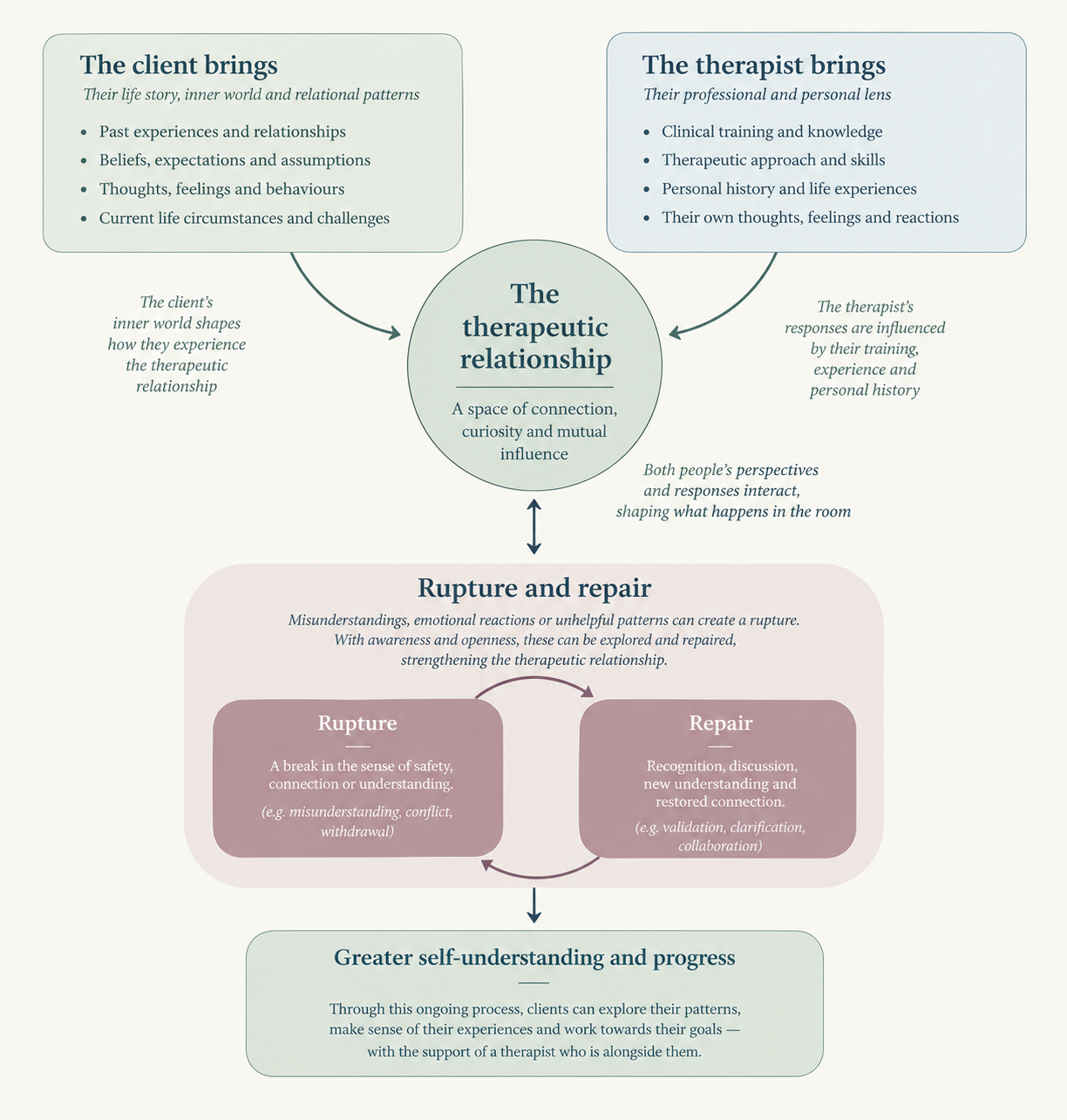
Note. Original illustration generated with the assistance of AI and reviewed by the author for clinical accuracy.
The Role of Culture
In today's increasingly interconnected and culturally diverse world, therapy brings together people with different cultural backgrounds, languages, values and life experiences. These differences can enrich the therapeutic relationship, but they can also influence how a therapist understands a client and responds to them.
For example, a therapist who places a strong emphasis on individual autonomy might interpret a client's sense of responsibility towards their family as difficulty setting boundaries, overlooking the cultural or personal meaning of family obligation. Similarly, a therapist might interpret a client's quietness as disengagement when it reflects their communication style, language processing or expectations of a professional relationship.
These assumptions can shape a therapist's emotional responses, including feeling concerned, frustrated or uncertain about how to help. This is where cultural humility and curiosity becomes important: recognising the limits of our own perspective, remaining curious about differences, and being willing to question our assumptions.
No two people have exactly the same cultural experience, even when they share a cultural background. By exploring differences collaboratively rather than making assumptions, therapists and clients can develop a deeper understanding of one another and work through misunderstandings when they arise.
Some Examples of Countertransference
The following examples illustrate just some of the ways countertransference may show up in therapy. Your therapist's experiences and reactions may look quite different.
1. “I really want to fix things and find solutions for this client.”
Imagine a client who grew up with controlling parents who made decisions and solved problems on their behalf. As an adult, the client finds it difficult to trust their own judgement and make decisions independently.
Their therapist, who is naturally inclined towards helping others and may have their own personal reasons for valuing care and responsibility, notices a strong urge to offer solutions, give advice or help the client make a decision — particularly when the client is distressed or facing a difficult situation.
What might be happening?
The therapist may feel protective of the client or uncomfortable witnessing their distress. They may also feel that offering a solution is the quickest way to help. Meanwhile, the client may be seeking reassurance or guidance because uncertainty feels difficult to tolerate.
If the therapist consistently steps in to solve problems, the client may have fewer opportunities to develop confidence in their own judgement and capacity to manage uncertainty. The therapeutic relationship could unintentionally begin to resemble a dynamic in which someone else takes responsibility for the client's decisions.
Reflecting on the urge to fix things can help the therapist consider what the client needs in that moment: practical support, emotional validation, collaborative problem-solving or space to work things out at their own pace.
The goal is not to withhold help, but to provide support in a way that strengthens the client's sense of agency and independence.
2. “I raised a difficult observation, and my client didn't respond well. I wonder if I've upset them.”
Imagine a client who grew up experiencing frequent criticism, rejection or bullying. These experiences may contribute to them becoming particularly sensitive to situations in which they feel judged or misunderstood, which can make it more difficult to navigate conflicts at work and with friends.
Their therapist notices that they are becoming hesitant to raise a difficult observation, explore a recurring pattern or ask a question that might bring up painful feelings.
What might be happening?
The therapist may be responding to the client's distress or anticipating that the client will feel criticised or rejected. The therapist may also have their own discomfort with conflict or a wish to be liked and avoid upsetting others.
Reflecting on these responses can help the therapist distinguish between being appropriately sensitive to the client's needs and avoiding a conversation that might be therapeutically valuable.
However, it is equally important not to assume that the client's reaction is simply a result of their past experiences. Perhaps the observation was inaccurate, the timing was unhelpful, or the therapist expressed it in a way that felt critical. The client may have a valid reason for feeling hurt or misunderstood.
Exploring what happened together can help both people understand the client's experience and the therapist's intentions. Over time, this may create opportunities for the client to express disagreement, communicate hurt and discover that difficult conversations can be approached with curiosity and repaired — rather than necessarily leading to rejection.
3. “I feel frustrated that my client seems to be caught in the same cycle, even though we've discussed it many times.”
A therapist feels frustrated when a client repeatedly describes a difficult situation but struggles to make changes, or returns to a familiar pattern despite recognising its consequences.
This could involve a client who is considering leaving a relationship, reducing their substance use or changing careers. The therapist has explored the client's motivations and barriers, discussed strategies and tried to remain patient, yet the situation seems unchanged.
What might be happening?
The therapist may feel concerned about the client's wellbeing, impatient to see progress or uncertain about how to help. Their frustration might also reflect a mismatch in the pace or goals of therapy, or a sense that they are working harder towards change than the client feels ready or able to.
Rather than assuming that the client is resistant or unmotivated, the therapist can use this response as an opportunity to reflect on what might be making change difficult. The client may be experiencing fear, ambivalence, practical barriers or competing priorities. They may also feel that the therapist has not fully understood their circumstances.
If the client is also feeling frustrated or stuck, discussing this together can help them revisit their goals, reconsider the therapeutic approach and identify barriers that have not yet been addressed. When handled thoughtfully, these conversations can strengthen collaboration and help therapy move forward.
4. “What my client is describing reminds me of something that happened to me or someone close to me.”
This may be more common than you think. Many human experiences, such as grief, relationship difficulties and career changes, are familiar to us in some way.
When a client's experiences, personality or relationship difficulties feel particularly familiar, a therapist may find themselves drawing parallels with their own life.
What might be happening?
Shared experiences can deepen understanding and empathy. However, familiarity can also make it easier to assume that we know what another person is experiencing.
For example, a therapist who has experienced a painful breakup may feel a strong desire to reassure a client that they will eventually find someone better. Although this may come from a caring place, it might not reflect what the client needs. The client may want to understand their grief, explore their own contribution to the relationship or simply have space to feel what they are feeling without being encouraged to move on.
A heart surgeon does not need to have experienced the same heart condition as their patient to provide effective care. Similarly, a therapist does not need to have experienced the same life event as a client to understand and support them.
Empathy involves being willing to understand another person's perspective, rather than assuming that their experience is identical to our own. By recognising when their personal experiences are influencing their responses, therapists can remain curious about the client's individual story and avoid imposing their own interpretations or solutions.
Therapists differ in how much personal information they share with clients. Self-disclosure can sometimes be helpful, but it is not necessary for empathy or effective therapy. The decision to share should be guided by whether it is likely to benefit the client and support the therapeutic work.
What To Do
We won't go into detail here about how therapists manage countertransference in their clinical practice. From a client's perspective, however, there are a few things worth keeping in mind.
If your therapist shares an observation about their experience of working with you, you might feel curious, relieved, uncomfortable or even misunderstood. You do not need to agree with their interpretation simply because they are the therapist.
If you feel ready, you can share your own response and ask questions. For example, you might say, “I'm curious about what you noticed,” or “When you said that, I felt a little misunderstood. Can we explore that?”
You can also raise concerns if something your therapist has said or done has affected your trust or sense of safety. A good therapeutic relationship does not require you to avoid disagreement or protect your therapist from uncomfortable feelings.
These conversations can create opportunities to understand one another better, address misunderstandings and work through difficulties in the therapeutic relationship. Your therapist's clinical judgement should support this process, but your perspective and experience are essential to it.
You are also not responsible for managing your therapist's emotions. It is the therapist's responsibility to reflect on their responses, maintain appropriate professional boundaries and seek supervision when needed.
The Path Forward
If any of these examples feel familiar, you are not alone.
Countertransference is a natural part of the therapeutic relationship. When approached with curiosity and care, a therapist's emotional responses can offer opportunities for greater understanding and growth.
Therapy isn't about finding a therapist who never has feelings, but one who reflects on them thoughtfully and works collaboratively with you, so your experiences are heard, respected and understood.
If this resonates with you and you would like to explore therapy, we'd love to hear from you. Rhythm Clinical Psychology is based in Surry Hills, Sydney, and we also offer telehealth sessions to clients elsewhere in Australia.
You can reach us at info@rhythmclinicalpsychology.au or call 0414 824 375.
This is the second article in our series on The Therapeutic Relationship. You can read the first article on transference here and the third article on rupture and repair in therapy here.

-
This article is provided for general informational and educational purposes only and is based on psychological theory and clinical experience. It is not intended to be, and should not be used as, a substitute for professional psychological assessment, diagnosis, or treatment.
The content reflects general patterns observed in clinical practice and may not apply to all individuals. If you are experiencing distress or relate to the material discussed, you are encouraged to seek support from a qualified health professional, such as a registered psychologist, or to discuss your concerns with your treating clinician.
This information is not a substitute for personalised care.
-
American Psychological Association. (n.d.). Countertransference. In APA dictionary of psychology. Retrieved October 16, 2026, from https://dictionary.apa.org/countertransference
Hayes, J. A., Gelso, C. J., & Hummel, A. M. (2011). Managing countertransference. Psychotherapy, 48(1), 88–97. https://doi.org/10.1037/a0022182
Hayes, J. A., Gelso, C. J., Goldberg, S., & Kivlighan, D. M. (2018). Countertransference management and effective psychotherapy: Meta-analytic findings. Psychotherapy, 55(4), 496–507. https://doi.org/10.1037/pst0000189
6 Nov 2026
By Dr Jichun (Jess) Hao, Clinical Psychologist | Rhythm Clinical Psychology, Sydney