30 Oct 2026
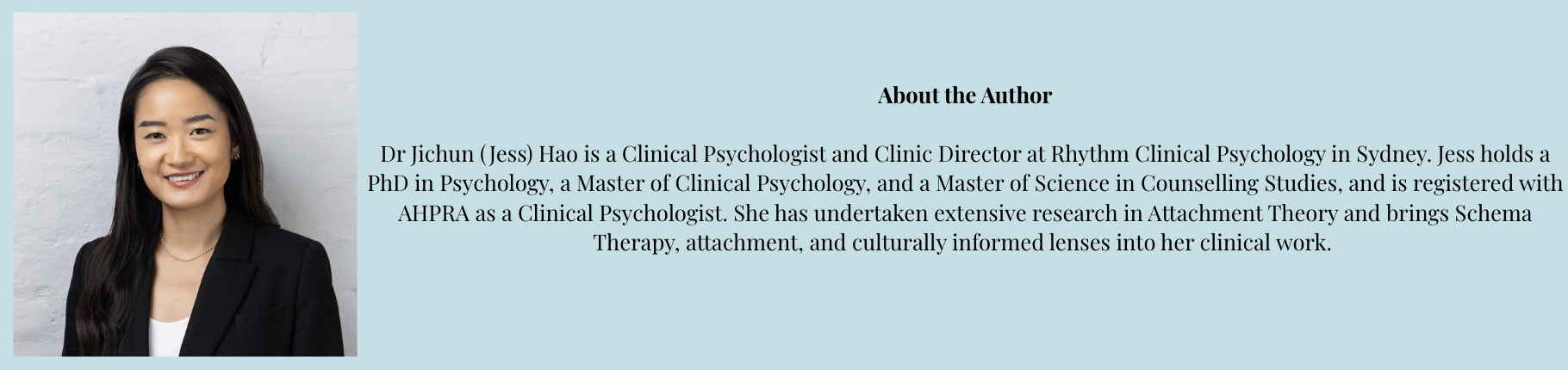
By Dr Jichun (Jess) Hao, Clinical Psychologist | Rhythm Clinical Psychology, Sydney
In This Article
Christmas can bring up complicated emotions, particularly when family expectations, cultural values, and longstanding relationship patterns come together. In this article, we explore how Schema Therapy can help us understand why we might feel lonely, guilty, or unlike ourselves around family, even when everything appears fine on the surface. We’ll look at three common schemas that may be activated during Christmas, how our early experiences and emotional needs can shape these patterns, and why understanding our families doesn't always make difficult feelings go away.
When Old Family Patterns Resurface at Christmas
Enmeshment - “Can I Be Myself Without Feeling Disloyal?”
Emotional Deprivation - “Will My Emotional Needs Be Met”
Unrelenting Standards - “Am I Allowed To Let Things Be Imperfect?”
How Culture Might Shape Our Experiences of Christmas
Key Takeaways
Christmas can bring old patterns to the surface. You might find yourself feeling or behaving differently around family, even when you generally feel confident and independent in everyday life.
Unmet emotional needs can shape how we experience family relationships. Early experiences may influence whether we feel free to be ourselves, emotionally understood, or under pressure to meet high expectations.
Culture can shape our expectations of family. Values such as filial piety and family harmony can foster connection and belonging, while sometimes creating tension between family obligations and our own needs.
Understanding your family doesn't automatically change how you feel. You can appreciate your family's intentions while still experiencing loneliness, guilt, or unmet emotional needs.
Recognising your patterns is a starting point for change. Understanding your emotions and the patterns behind them can help you find new ways of relating to yourself and your family.
When Old Family Patterns Resurface at Christmas
It is not uncommon for people to experience grief, guilt, or a sense of emptiness during Christmas gatherings. These feelings may arise in the context of grief and loss (e.g., remembering a loved one who has passed away), family estrangement, divorce or relationship breakdown, or navigating blended family dynamics.
But have you ever found yourself at a Christmas gathering where everything seems fine on the surface, yet deep down, you feel guilty, lonely, or even empty? Perhaps there is nothing obviously wrong, and everyone appears to be getting along, but something about being with your family still feels difficult. You might even find that, while you generally navigate everyday life confidently — making your own decisions, maintaining friendships, and expressing your opinions at work — something shifts when you're around your family. You become quieter, more accommodating, more defensive, or more concerned about pleasing others than you usually are.
For example, have you ever found yourself wondering:
Can I be myself without feeling disloyal? Can I make my own choices about how I spend Christmas, express different opinions, or set boundaries with my family without feeling guilty or worrying that I am disappointing them?
Will my emotional needs be met? Can I feel understood, supported and emotionally connected with my family, or will I leave another Christmas gathering feeling lonely, unseen or misunderstood despite being surrounded by people?
Am I allowed to let things be imperfect? Can I relax and enjoy Christmas without feeling responsible for making everything go smoothly, keeping everyone happy, or meeting the expectations I place on myself and others?
Christmas often carries significant social and cultural expectations about family, togetherness, and how we should feel during the holiday season. Returning to familiar family environments can activate longstanding schemas — deeply ingrained patterns involving our beliefs, emotions, memories, bodily sensations, and expectations about ourselves and our relationships, which can influence how we respond to situations and interact with others.
From a Schema Therapy perspective, these patterns can help us understand why family gatherings may bring up difficult emotions, even when everything appears to be fine on the surface. We explored schemas in more detail in an earlier article here.
-
According to Schema Therapy, we develop longstanding patterns of thinking, feeling, and relating to others, which are shaped by our early experiences and emotional needs.
Basic Emotional Needs
Schema Therapy proposes five core emotional needs that are important for healthy psychological development:
Secure attachment: to feel safe, loved, accepted, and connected to others.
Autonomy: to develop independence, confidence, and a stable sense of identity.
Freedom of expression: to feel able to express our emotions, needs, and opinions.
Spontaneity and play: to experience joy, creativity, curiosity, and enjoyment.
Realistic limits: to develop appropriate boundaries, self-control, and consideration for others.
When these needs are sufficiently met, we are more likely to develop a healthy sense of self, emotional resilience, and secure relationships.
However, when these needs are consistently unmet, particularly during childhood, we may develop Early Maladaptive Schemas (or schemas). These are deeply ingrained patterns involving our beliefs, emotions, memories, and expectations about ourselves and our relationships. They can continue to influence how we interpret situations, experience emotions, and respond to others, even long after the original experiences have passed.
Schemas can influence:
How we think about ourselves and the world around us (thoughts and beliefs).
How we emotionally experience ourselves and others (feelings).
How we respond and cope when our schemas are activated (coping styles).
Coping Styles
When a schema is activated, we may develop different ways of coping with the emotional distress it creates. Schema Therapy identifies three broad coping styles:
Surrender: accepting the schema as true and behaving in ways that reinforce it.
Avoidance: avoiding situations, thoughts, feelings, or relationships that might activate the schema.
Overcompensation: behaving in ways that appear to be the opposite of the schema, often in an attempt to protect ourselves from the underlying feelings or beliefs.
Over time, these coping styles can inadvertently reinforce our schemas, creating recurring patterns in how we think, feel, and relate to others.
We’ll explore how three common schemas, which we often see in our clients, may show up during Christmas.
Enmeshment - “Can I be myself without feeling disloyal?”
Christmas scenario -
Perhaps your family expects everyone to spend Christmas Day together, as they have always done. You would prefer to spend the morning quietly at home or alternate Christmas between your family and your partner's, but the thought of suggesting this fills you with guilt. You worry that your parents will feel rejected or that other family members will see you as selfish. So, you agree to the usual plans, even though part of you wishes you could make the decision that feels right for you.
Where the pattern might come from -
Over time, this pattern may have developed in an environment where family closeness and togetherness were strongly emphasised, but there was less room for autonomy, individual preferences, independence, or emotional separation. Perhaps your family expected you to share their opinions, prioritise family needs, or involve them in important decisions. You may have learned that expressing different preferences or pursuing your own interests could lead to disappointment, conflict, or feelings of guilt. As a result, developing a separate sense of identity may have felt difficult, particularly when it seemed to come at the expense of family connection.
How the pattern can continue -
When the Enmeshment schema is activated, it can be difficult to distinguish your own preferences and needs from those of your family. You may feel that making independent choices threatens your sense of connection or loyalty, making it difficult to develop a sense of self that exists alongside your family relationships.
You may also experience guilt when you try to honour your own preferences or make choices that differ from your family's expectations. We explore this experience further in our article about guilt.
Emotional Deprivation - “Will my emotional needs be met?”
Christmas scenario -
Perhaps you've had a difficult year and are hoping that Christmas will be an opportunity to reconnect with your family. During lunch, everyone talks about work, holidays, or what other family members have been up to. When someone asks how you're going, you briefly mention that things have been hard, but the conversation quickly moves on. Nobody seems to notice that you're struggling, and you don't feel comfortable bringing it up again. You smile, join in with the festivities, and go home feeling unexpectedly lonely, wondering why being surrounded by family hasn't left you feeling any closer to them.
Where the pattern might come from -
The Emotional Deprivation schema may develop when a person's emotional needs for warmth, empathy, understanding, protection, or guidance have not been adequately met over time. Perhaps caregivers were physically present and provided for practical needs, but struggled to recognise or respond to emotional needs. In some families, emotions may have been minimised, dismissed, or met with practical advice rather than emotional understanding. Over time, you may have learned not to expect much emotional support from others, even when you deeply long for it.
How the pattern can continue -
When the Emotional Deprivation schema is activated, you may expect that your emotional needs for warmth, empathy, understanding, or support will not be adequately met. Even when family members are physically present and the gathering appears pleasant, you may feel that the emotional connection you long for is missing.
Unrelenting Standards - “Am I allowed to let things be imperfect?”
Christmas scenario -
Perhaps you're hosting Christmas lunch and have spent days planning the menu, buying gifts, cleaning the house, and making sure everyone has what they need. On Christmas morning, you're still in the kitchen while everyone else is relaxing. When the food is ready, you notice that one dish is overcooked and immediately feel frustrated with yourself. Even when your family tells you that everything is lovely, you struggle to take it in because you're focused on what went wrong and what you should have done differently. By the end of the day, everyone else has enjoyed Christmas, but you feel exhausted and disappointed in yourself.
Where the pattern might come from -
This schema may develop in environments where there was strong emphasis on achievement, meeting high expectations, and getting things right, with less room for children to make mistakes, express their needs, or feel accepted and valued regardless of their performance. Perhaps you grew up feeling that mistakes were met with criticism, that praise was conditional on doing well, or that you needed to be responsible and capable beyond what was developmentally expected of you. Alternatively, you may have internalised high standards by observing important people in your life who were particularly perfectionistic or self-critical. Over time, you may have come to believe that you need to perform well, avoid mistakes, or meet demanding standards to feel good enough or gain approval.
How the pattern can continue -
When the Unrelenting Standards schema is activated, you may feel driven to meet demanding expectations, avoid mistakes, or ensure that everything is done properly. Rather than allowing yourself to enjoy the occasion, you may become preoccupied with imperfections and judge yourself harshly when things do not meet your expectations.
How Culture Might Shape Our Experience of Christmas
In Australia's multicultural society, Christmas can mean different things to different families. Our expectations around family, togetherness, and how we celebrate are often shaped by the cultural values we grew up with, as well as the social expectations around us.
For example, in some families influenced by Confucian traditions, filial piety — respect for and care towards parents — may shape expectations about spending Christmas together or prioritising family obligations. In other families, family harmony may be particularly valued, making it difficult to express disagreement or raise uncomfortable feelings during what is expected to be a joyful occasion. At the same time, broader Australian expectations of Christmas as a time for family togetherness can add another layer of pressure, particularly when our own preferences or family circumstances don't fit this ideal.
Navigating these different expectations can sometimes leave us feeling caught between wanting to honour our family and cultural values and wanting to make choices that reflect our own needs. These values can offer a deep sense of connection and belonging, but depending on how they are experienced within a family, they can also create tension around independence, emotional expression, and family relationships.
When Understanding Your Family Doesn't Make It Hurt Less
You might intellectually understand why your family members behave the way they do. Perhaps you recognise that your parents have good intentions, understand that they express care differently, or appreciate the pressures and experiences that have shaped them. You may even be able to explain why certain family dynamics have developed over time. Yet, despite this understanding, you might still feel lonely, guilty, misunderstood, or unseen when you're around them.
Sometimes, understanding where a pattern comes from can make it easier to have compassion for others, but it doesn't necessarily change how we feel when we experience that pattern ourselves. For example, you might:
Understand why a family member struggles to express affection, while still longing for greater emotional closeness.
Appreciate your family's expectations, while still feeling conflicted about being true to yourself.
Understanding a pattern and changing how we experience it are two different things. Recognising that a schema may be activated is an important starting point, but it doesn't automatically change the emotions, expectations, or familiar responses associated with it. As we explored in our earlier article, Insight Alone Doesn't Create Change, intellectual understanding is not always enough to shift longstanding emotional and relational patterns.
This is particularly relevant when it comes to family relationships, where familiar dynamics may have developed over many years. The aim isn't necessarily to blame our families, dismiss the care they show us, or assume that every difficult feeling reflects a dysfunctional relationship. Rather, it is to:
Understand our emotions and recognise our patterns.
Find new ways of relating to ourselves and our families.
The Path Forward
If this feels familiar, you are not alone.
Understanding why Christmas gatherings can bring up difficult emotions is a starting point for making sense of our experiences. Our family relationships, cultural values, and longstanding emotional patterns can all shape how we experience these occasions. While we may not be able to change our family dynamics overnight, we can begin to better understand our emotional needs and the patterns that influence how we relate to ourselves and others.
If this resonates with you and you would like to explore therapy, we would love to hear from you. Rhythm Clinical Psychology is based in Surry Hills, Sydney, and we also offer telehealth sessions for those based elsewhere in Australia. You can reach us at info@rhythmclinicalpsychology.au or by calling 0414 824 375.
-
This article is provided for general informational and educational purposes only and is based on psychological theory and clinical experience. It is not intended to be, and should not be used as, a substitute for professional psychological assessment, diagnosis, or treatment.
The content reflects general patterns observed in clinical practice and may not apply to all individuals. If you are experiencing distress or relate to the material discussed, you are encouraged to seek support from a qualified health professional, such as a registered psychologist, or to discuss your concerns with your treating clinician.
This information is not a substitute for personalised care.
-
Schwartz, S. J., Weisskirch, R. S., Hurley, E. A., Zamboanga, B. L., Park, I. J. K., Kim, S. Y., Umaña-Taylor, A., Castillo, L. G., Brown, E., & Greene, A. D. (2010). Communalism, familism, and filial piety: Are they birds of a collectivist feather? Cultural Diversity and Ethnic Minority Psychology, 16(4), 548–560. https://doi.org/10.1037/a0021370
The Schema Therapy Model. Retrieved from https://schematherapysociety.org/Schema-Therapy on 15th of May 2026.
Young, J. E., Klosko, J. S., & Weishaar, M. E. (2006). Schema therapy: A practitioner's guide. Guilford press.
30 Oct 2026
By Dr Jichun (Jess) Hao, Clinical Psychologist | Rhythm Clinical Psychology, Sydney