20 Nov 2026
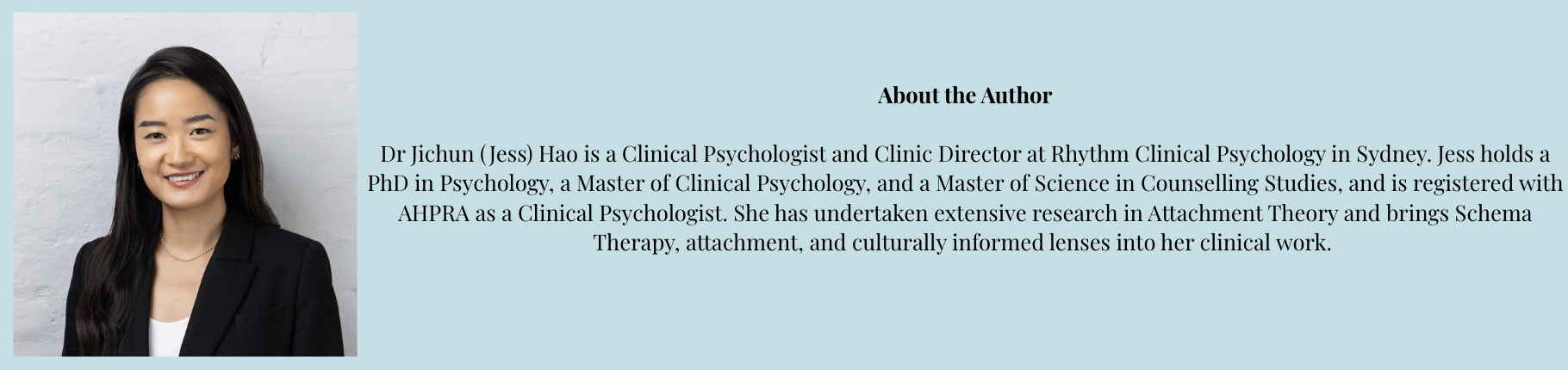
By Dr Jichun (Jess) Hao, Clinical Psychologist | Rhythm Clinical Psychology, Sydney
In This Article
Healthcare professionals spend much of their working lives caring for others, yet many find it difficult to recognise, prioritise or receive care for their own emotional needs. Why can asking for support feel so uncomfortable, even when we understand its importance? Drawing on Schema Therapy, this article explores three early maladaptive schemas – Self-Sacrifice, Emotional Inhibition and Mistrust/Abuse – and how they may influence the way healthcare professionals relate to vulnerability, emotional support and dependence on others. We also consider how these patterns can develop through early experiences and become reinforced by professional expectations and workplace environments.
Key Takeaways
Being skilled at caring for others does not necessarily mean feeling comfortable receiving care. Like Jamie, healthcare professionals may understand the importance of emotional support while struggling to acknowledge or communicate their own needs.
Self-Sacrifice can make it difficult to prioritise personal needs, particularly when someone's sense of worth is closely tied to being helpful or putting others first.
Emotional Inhibition can make expressing vulnerability feel uncomfortable or unsafe, especially when remaining composed has become closely connected to one's professional identity.
Mistrust/Abuse can make it difficult to rely on others, disclose personal struggles or accept support, particularly when there is an expectation of being hurt, judged or let down.
Professional environments can reinforce existing patterns. Expectations around composure, dedication and self-reliance may strengthen beliefs that make it harder to seek or receive care.
These qualities are not inherently problematic. Compassion, independence and emotional composure can be valuable strengths; difficulties arise when these patterns become rigid and come at the expense of one's own emotional wellbeing.
Jamie’s Paradox
Jamie is 32 and has been working in healthcare for eight years. Like many of their colleagues in the multidisciplinary team, Jamie finds it deeply rewarding to support patients and contribute to their recovery. They:
go above and beyond what is expected,
spend their weekends reading the latest research,
Always think about how they might improve patient outcomes.
However, when it comes to receiving support themselves, particularly emotional support and care, Jamie finds it much more difficult. They might work through their lunch break to help a colleague or continue supporting patients even when they are experiencing distress themselves. Their own needs often take a back seat.
As a healthcare professional, Jamie understands the importance of self-care. They know the value of getting enough sleep, eating well and exercising regularly. They frequently read self-help books and listen to podcasts about mental health and wellbeing. They recognise that they are often much harder on themselves than they would ever be towards another person.
Yet, despite this awareness, Jamie finds it difficult to change the pattern of consistently prioritising other people's needs over their own. And this doesn't just happen at work. The same tendency shows up in their relationships with family and friends, where they often find themselves taking responsibility for others while struggling to ask for or accept support in return.
Jamie finds themself asking:
“Why can it feel so much easier to care for others than to allow myselves to be cared for?”
Does this sound familiar?
This difficulty is not simply an individual experience. A 2025 systematic review and meta-analysis by Kuosmanen and colleagues examined 16 studies exploring the perceived need for, and help-seeking behaviours around, psychosocial support among health and social care professionals. The review found that, across the included studies, the weighted average of professionals seeking formal support was 30.2%, compared with 67.4% seeking informal support. The review also identified barriers to help-seeking, including concerns about confidentiality, embarrassment and stigma, with some professionals expressing a preference for managing difficulties independently. Although these findings relate to help-seeking rather than the broader experience of receiving emotional care, they highlight an important tension:
Recognising the need for support does not always translate into feeling comfortable seeking it.
In a previous article, we explored why insight alone does not necessarily lead to behavioural or emotional change, and how Schema Therapy can help us understand the deeper patterns that keep us stuck. In this article, we explore how Schema Therapy can also help us understand why some healthcare professionals find it particularly difficult to recognise, prioritise and receive care for their own emotional needs.
-
According to Schema Therapy, we develop longstanding patterns of thinking, feeling, and relating to others, which are shaped by our early experiences and emotional needs.
Basic Emotional Needs
Schema Therapy proposes five core emotional needs that are important for healthy psychological development:
Secure attachment: to feel safe, loved, accepted, and connected to others.
Autonomy: to develop independence, confidence, and a stable sense of identity.
Freedom of expression: to feel able to express our emotions, needs, and opinions.
Spontaneity and play: to experience joy, creativity, curiosity, and enjoyment.
Realistic limits: to develop appropriate boundaries, self-control, and consideration for others.
When these needs are sufficiently met, we are more likely to develop a healthy sense of self, emotional resilience, and secure relationships.
However, when these needs are consistently unmet, particularly during childhood, we may develop Early Maladaptive Schemas (or Schemas). These are deeply ingrained patterns involving our beliefs, emotions, memories, and expectations about ourselves and our relationships. They can continue to influence how we interpret situations, experience emotions, and respond to others, even long after the original experiences have passed.
Schemas can influence:
How we think about ourselves and the world around us (thoughts and beliefs).
How we emotionally experience ourselves and others (feelings).
How we respond and cope when our schemas are activated (coping styles).
Coping Styles
When a schema is activated, we may develop different ways of coping with the emotional distress it creates. Schema Therapy identifies three broad coping styles:
Surrender: accepting the schema as true and behaving in ways that reinforce it.
Avoidance: avoiding situations, thoughts, feelings, or relationships that might activate the schema.
Overcompensation: behaving in ways that appear to be the opposite of the schema, often in an attempt to protect ourselves from the underlying feelings or beliefs.
Over time, these coping styles can inadvertently reinforce our schemas, creating recurring patterns in how we think, feel, and relate to others.
In the next section, we will explore several early maladaptive schemas that may be relevant to the experiences of healthcare professionals, including how these patterns can develop and become reinforced over time. These are not an exhaustive list, and other schemas may also be relevant depending on an individual's personal experiences and circumstances. Rather than focusing on how to change these schemas, we will look at the beliefs and emotional needs that may sit underneath them. If you would like to learn more about how schemas can be changed, we explore this in our previous article: When Insight Alone Doesn't Always Lead to Change.
Self-Sacrifice: "Other people's needs should come before my own."
People with this schema tend to prioritise the needs of others, sometimes at the expense of their own wellbeing. They may feel guilty when focusing on themselves, struggle to say no or worry that others will suffer if they don't step in to help.
It is worth considering how this schema might intersect with a career in healthcare. People who place a strong value on caring for others may find meaning and fulfilment in helping professions. For someone who already has a Self-Sacrifice schema, working in healthcare may further reinforce this pattern. The opportunity to care for others is not only professionally valued but can also bring emotional rewards, recognition and a sense of purpose. Over time, consistently putting others first may become closely tied to how they understand their professional identity and personal worth (e.g., “A good clinician is someone who always puts their patients' needs first”).
Some childhood experiences that may contribute to the development of this schema include growing up with parents/caregivers who similarly prioritised others' needs, being raised in families or cultural environments where self-sacrifice was strongly valued and prioritising oneself was viewed as selfish, or taking on a caregiving role within the family from an early age. For example, a child may have learnt to monitor and respond to a parent's emotional needs, mediate family conflict or take responsibility for keeping relationships harmonious.
Over time, these experiences may contribute to the belief that one's own emotional needs are less important than those of others, or that maintaining relationships requires putting others first. In adulthood, this pattern may continue through different coping modes/styles. Some individuals may overcompensate by continually and actively doing more for others, while others may surrender to the schema by automatically overlooking or minimising their own needs.
Emotional Inhibition: "I shouldn't show my feelings or let others see me struggle."
People with this schema tend to suppress their emotions and find it difficult to express their feelings, particularly when doing so might make them appear vulnerable, emotional or out of control. They may worry about being judged, embarrassing themselves or burdening others with their emotional needs. As a result, they might find it easier to intellectualise their experiences or focus on practical solutions rather than acknowledge and express how they actually feel.
One could argue that working in healthcare may further reinforce this schema. Healthcare professionals are often expected to remain composed, make rational decisions and maintain professional boundaries, even when working in emotionally demanding situations. While emotional regulation is an important professional skill, individuals with this schema might find it difficult to distinguish between regulating their emotions and suppressing them altogether. Over time, being able to remain composed and contain their emotions may become closely tied to their professional identity (“I need to remain calm and composed, regardless of how I'm feeling.”), making it even harder to express vulnerability or seek emotional support.
Some childhood experiences that might have contributed to the development of this schema include growing up in families where emotions were rarely discussed or openly expressed, having parents/adults who dismissed or minimised emotional experiences, or learning that expressing certain emotions would lead to criticism, rejection or conflict either with peers/adults.
As a result, these individuals may come to believe that expressing their emotions is inappropriate, unhelpful or even unsafe. At times, they may surrender to the belief that they need to remain composed by keeping their feelings to themselves; avoid vulnerability by withdrawing from emotional conversations or convincing themselves they do not need support; or overcompensate by presenting as particularly capable and self-sufficient, even when they are struggling. Even when they recognise that they need care, allowing someone else to see their vulnerability can feel unfamiliar and uncomfortable.
Mistrust / Abuse: "I cannot fully trust others to treat me with care or respect."
People with this schema tend to expect that others may intentionally hurt, manipulate, exploit or take advantage of them. They may find it difficult to trust others' intentions, particularly when it involves allowing themselves to become emotionally vulnerable or dependent on someone else. Even when others offer genuine care and support, they might question their intentions or anticipate that they will eventually be disappointed or let down.
It is possible that this schema may present particular challenges in healthcare settings, where professionals are required to collaborate with colleagues, delegate responsibilities and rely on others' clinical judgement. For someone with a Mistrust/Abuse schema, trusting another person's decisions or allowing someone else to take responsibility may feel particularly uncomfortable. They may prefer to maintain control and rely on themselves rather than risk being disappointed, exploited or let down. This can also extend beyond the workplace, making it difficult to accept emotional support from friends, family or even their own healthcare professionals.
Some childhood experiences that might have contributed to the development of this schema include growing up with caregivers who were unpredictable, critical, controlling or emotionally or physically abusive. Experiences of betrayal, broken trust, manipulation or having personal boundaries repeatedly violated may also contribute to the development of this schema.
As a result, these individuals may develop a deep-seated expectation that other people cannot always be trusted, particularly when they are in a vulnerable position. They might surrender to the belief that others cannot be trusted by remaining guarded and expecting to be let down; avoid potential hurt by keeping others at a distance or avoiding situations that require vulnerability; or overcompensate by becoming overly self-reliant, maintaining control or being reluctant to depend on anyone. Even when they genuinely want support, the possibility of being hurt, judged or taken advantage of may make it difficult to let others get close.
When Do These Patterns Become a Problem?
Of course, not all healthcare professionals have these schemas, and having these schemas does not necessarily mean that something is wrong. In fact, some of the underlying qualities associated with these patterns, such as compassion, generosity, emotional composure and independence, can be valuable qualities in a healthcare professional. The intention is not to suggest that caring deeply for others, maintaining professional composure or being self-reliant are inherently problematic. Rather, difficulties can arise when these patterns become so rigid that they come at the expense of one's own emotional needs and wellbeing.
For example, when caring for others means consistently neglecting your own needs; when maintaining composure means feeling unable to express vulnerability or ask for support; or when independence makes it difficult to trust others, accept help or allow yourself to depend on someone. It is not necessarily the presence of these schemas that matters, but how strongly they influence the way we relate to ourselves and others, and whether they begin to interfere with our wellbeing.
Ultimately, these patterns can help us understand why receiving care may feel so unfamiliar or uncomfortable, even for people who spend much of their lives caring for others. For someone like Jamie, the difficulty may not be a lack of awareness about the importance of support, but deeper beliefs about whose needs matter, what it means to show vulnerability, and whether others can be trusted to respond with care. Recognising these patterns can be an important first step towards understanding our relationship with our own emotional needs.
“The curious paradox is that when I accept myself just as I am, then I change.”
— Carl Rogers
The Path Forward
If this feels familiar, you are not alone.
As healthcare professionals, you may be accustomed to being the person others turn to for support. But you deserve care and understanding, too. Therapy can offer a space to step outside the role of the capable clinician, make sense of patterns that may have developed over time, and explore your own emotional needs without feeling that you have to manage everything on your own.
If this resonates with you and you would like to explore therapy, we would love to hear from you. Rhythm Clinical Psychology is based in Surry Hills, Sydney, and we also offer telehealth sessions for those based elsewhere in Australia. You can reach us at info@rhythmclinicalpsychology.au or by calling 0414 824 375.
-
This article is provided for general informational and educational purposes only and is based on psychological theory and clinical experience. It is not intended to be, and should not be used as, a substitute for professional psychological assessment, diagnosis, or treatment.
The content reflects general patterns observed in clinical practice and may not apply to all individuals. If you are experiencing distress or relate to the material discussed, you are encouraged to seek support from a qualified health professional, such as a registered psychologist, or to discuss your concerns with your treating clinician.
This information is not a substitute for personalised care.
-
Kuosmanen, O., Jääskeläinen, E., Torkki, P., Seppälä, K., & Tuunainen, E. (2025). Perceived need and help-seeking for psychosocial support among health and social care professionals: A systematic review and meta-analysis. BMC Health Services Research, 25, 1455. https://doi.org/10.1186/s12913-025-13214-6
Rogers, C. R. (1961). On becoming a person: A therapist's view of psychotherapy. Houghton Mifflin.
Young, J. E., Klosko, J. S., & Weishaar, M. E. (2006). Schema therapy: A practitioner's guide. Guilford press.
20 Nov 2026
By Dr Jichun (Jess) Hao, Clinical Psychologist | Rhythm Clinical Psychology, Sydney